
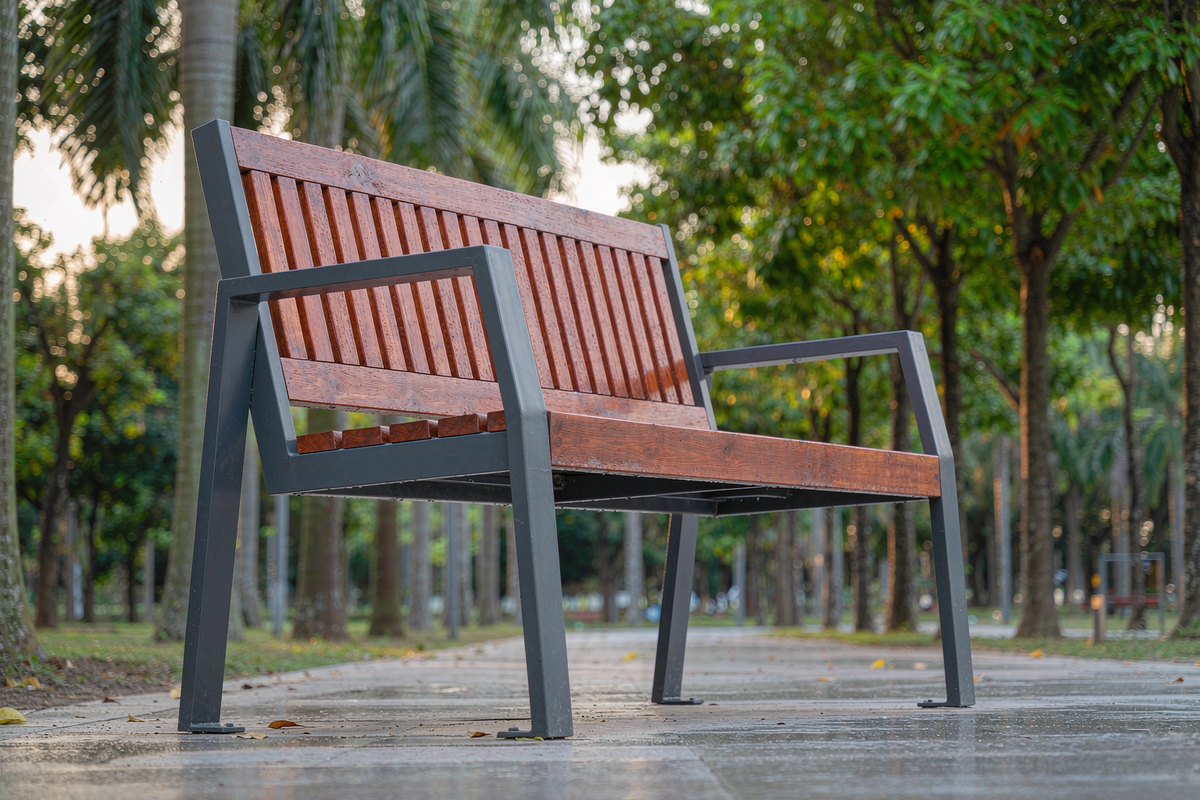
At a glance
- Usable seat depth on most public benches lands around 40-45 cm; the overall depth on the drawing runs 42-69 cm across the LVEN bench range because backrest, arms and frame sit behind and beside the seat.
- A reclined backrest eats 5-10 cm of that footprint, so a 50 cm deep bench can still deliver a 42 cm seat.
- Backless benches are shallower - 42-52 cm overall - and read as perches: right at a transit stop, less so for a 40-minute lunch.
- Depth only works when it is checked together with seat height, clear footway width and the fixing method.
Why is the depth on the drawing not the seat depth?
Almost every bench drawing gives three numbers: length, width and height. The width is the overall footprint, measured from the front edge of the seat to the furthest point at the back - usually the backrest frame, the rear leg or the arm. None of that rear portion is sitting space.
Usable seat depth is measured at seat level, from the front edge to the point where the backrest meets the body. On a bench with a raked back this is noticeably shorter than the footprint. A 50 cm overall depth with a 12 degree backrest rake and a 4 cm backrest frame typically leaves around 42 cm of seat - so two benches with the same catalogue depth can feel completely different.
What is a comfortable seat depth?
For most adults, a usable seat depth of roughly 40-45 cm lets the back reach the backrest while the knees still bend comfortably over the front edge. Shorter users, and many older visitors, are happier at 40-42 cm: deeper seats leave them perched forward with unsupported backs. Taller users are comfortable up to about 48 cm, beyond which the front edge starts to press behind the knee.
That is why 42-45 cm is so common in public seating: it works across the widest range of bodies without a cushion. Shallower seats under about 38 cm are leaners and perches, fine at bus stops and queue lines. Seats over 50 cm of usable depth belong in low-traffic gardens, not beside a busy footway.
These figures describe common practice, not a legal requirement. Accessibility rules differ between markets and the project specification takes precedence, so test the depth against the actual user group - especially in schemes aimed at older residents or children.
How do backrest and armrests change the number?
The backrest does two things at once: it supports the lumbar area, and it consumes depth. A near-vertical back at 5-8 degrees costs little; a relaxed 15 degree rake costs 8-10 cm of footprint before the backrest frame is even counted. On benches where the backrest is mounted on the rear of the seat frame, as on our OTY-42, the frame is slim and most of the 50 cm overall depth survives as seat.
Armrests are different. They add width and a little depth at the ends, but they do not shorten the seat in the middle. What they do is define where people sit: a bench with arms at both ends and a divider in the middle reads as individual seats, and each seat is measured between the arms rather than across the full length. Our guide to bench armrests and dividers sets out the spacing that keeps those seats usable.
Seat height matters here too. A 45 cm high seat with a 45 cm depth is a different experience from a 42 cm high seat at the same depth, because the knee angle changes. The seat height guide covers that dimension separately.
What depths does the LVEN bench range use?
The range spans 42-69 cm of overall depth, which reflects how differently the benches are meant to be used rather than a random spread of sizes.
| Model | Type | Overall depth | Height | Material |
|---|---|---|---|---|
| OTD-25A | Backless | 42 cm | 45 cm | Galvanized steel |
| OTD-59 | Backless | 43 cm | 46 cm | Stainless steel + PS poly wood |
| OTD-42 | Backless | 45 cm | 45 cm | Galvanized or stainless steel |
| OTD-29 | Backless | 46 cm | 42 cm | Stainless steel + PS poly wood |
| OTY-42 | With backrest | 50 cm | 78 cm | Galvanized or stainless steel |
| OTY-54 | With backrest / backless | 60 / 56 cm | 80 / 42 cm | Stainless steel + PS poly wood |
| OTY-19 | With backrest | 68 cm | 80 cm | Cast aluminum |
| OTY-68 | With backrest | 69 cm | 80 cm | Stainless steel |
The shallow group is a pause without occupying much pavement. The 45-50 cm group is the general-purpose park and promenade bench. The 60-69 cm group suits places where people settle - a garden, a lake edge, a terrace - with room to give the extra footprint away.
How does depth affect the space around the bench?
A bench is never alone. Its depth adds to whatever clear zone the footway must keep, and 20 cm of extra seat can turn a compliant path into a pinch point. On a 3 m promenade, a 69 cm deep bench set back into a planting bed is comfortable; the same bench pushed out from a wall narrows the route for every wheelchair, stroller and delivery cart that passes.
Test it in plan, not in a perspective render: draw the bench at true depth, add the clear width the path must keep, and check the gap to the traffic side. If that gap is tight, a shallower backless bench solves more than a prettier one. Completed layouts are in our projects gallery.
How do you check a depth before ordering?
Sit on the sample the way users will: with a coat, with a bag on the seat, with a child beside you, and after ten minutes rather than ten seconds. Three people of different heights will expose a depth that only works for one body type.
Without a sample, tape the footprint on the pavement and put a chair at the intended height. It catches the two mistakes that reach site: a seat too deep for older users, and a bench too deep for its footway. Then confirm the seat depth, not the overall width, in the purchase order.
Frequently asked questions
- What is the standard depth of a park bench?
There is no single standard. Public benches commonly measure about 42-52 cm in overall depth, which gives roughly 40-45 cm of usable seat once the backrest and frame are deducted. Backless benches sit at the shallow end, at about 42-50 cm overall. Confirm the usable seat depth and the local accessibility requirements for the specific project.
- Is a deeper park bench more comfortable?
Only up to a point. A usable depth of about 40-45 cm lets most adults reach the backrest with their knees bent over the front edge. Beyond roughly 48 cm, shorter users slide forward and lose back support, so a deeper bench can feel less comfortable than a shallower one. Deeper seats suit lounging in gardens and terraces rather than busy footways.
- How deep should a backless bench be?
Backless benches are usually 42-50 cm in overall depth, and that footprint is almost all usable seat. That makes them efficient on narrow paths and at transit stops, where people perch rather than settle. For long stays, a bench with a backrest at 45-50 cm overall depth is the better choice.
Specifying furniture for a public site? Send us the drawings or the site plan and we will confirm sizes, fixings and finishes with you.