
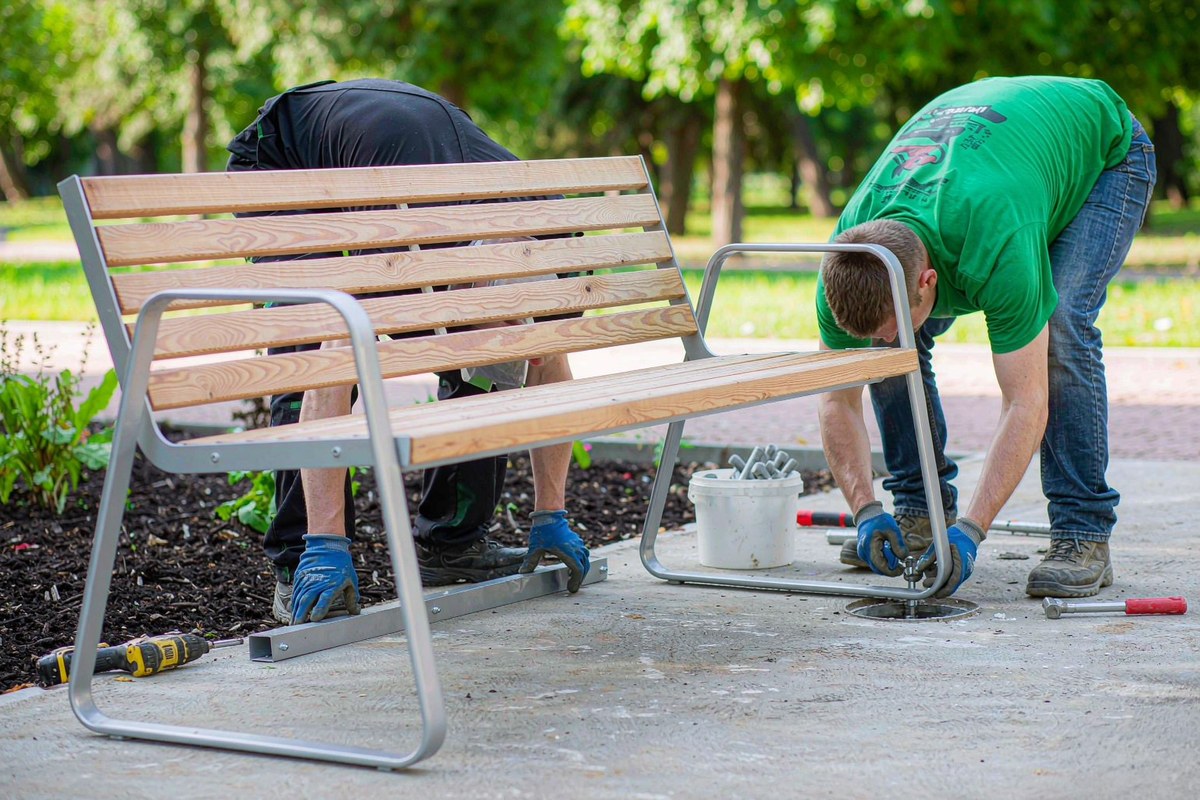
At a glance
- Anchor every public bench. Freestanding benches tip under load at the ends, drift out of alignment and walk away.
- Surface-mounted anchor bolts suit existing concrete; in-ground fixing with a footing suits soil, grass edges and new builds.
- Flat bar feet with pre-drilled holes make both methods a two-person, one-hour job.
- Anti-theft socket screws protect the bench and its fixings; re-torque after the first weeks of use.
Why does a public bench need anchoring at all?
A park bench is a lever. Sit on the end of an unanchored seat and the leverage multiplies body weight into a lifting force on the other side; the bench tips, rocks and gradually works its feet loose. Beyond the wobble, the consequences compound: a rocking bench reads as broken, users avoid it, and the movement opens gaps around fasteners where water sits and corrosion starts.
Then there is the simplest failure of all — the bench leaves. Lightweight or lightly fixed units are carried off for scrap or relocated by well-meaning volunteers to somewhere less suitable. Municipal buyers rarely lose sleep over the cost of a stolen bench; the real cost is the procurement round, the scheduling and the complaints in between. A properly anchored bench removes all three failure modes in one step, which is why we design our park benches with fixing points as standard rather than as an option.
Surface-mounted or in-ground fixing: which suits your site?
The two methods answer different site conditions, and choosing the wrong one is the most common installation mistake:
| Site condition | Recommended method | Why |
|---|---|---|
| Existing concrete slab or path | Surface-mounted anchor bolts | No breaking out concrete; the base plates bolt straight down |
| New paving being poured | Cast-in anchors or embedded legs | Fixings are set while the concrete is wet, leaving nothing to drill |
| Soil, grass edges, mulch beds | In-ground with a concrete footing | Only a footing below frost depth stops movement in soft ground |
| Timber decking | Surface-mounted to the bearers | Fixing into structural bearers, not deck boards, carries the load |
As a rule: if the ground is already sound and permanent, bolt down onto it; if it is not, or the bench is going into planted areas, fix into it. When in doubt, a small concrete pad poured for a surface mount is cheaper than excavating footings after the fact.
How do you install a surface-mounted bench, step by step?
On a prepared concrete base, a two-person crew with ordinary tools completes the job in about an hour:
- Position and mark. Set the bench in its final location, check sightlines and clearances, and mark through the pre-drilled holes in the feet.
- Drill and clean. Drill to the anchor manufacturer's diameter and depth, then blow the dust out — dust left in the hole can halve the holding power of an expansion anchor.
- Set the anchors. Insert sleeve or wedge anchors through the base plates, hammer them home, and leave the nuts loose enough to nudge the bench square.
- Level and tighten. Check the seat is level and the bench is in line with neighbouring furniture, then torque every nut to specification.
- Cover and re-check. Fit the protective caps, then re-torque after the first few weeks of use as the bedding settles.
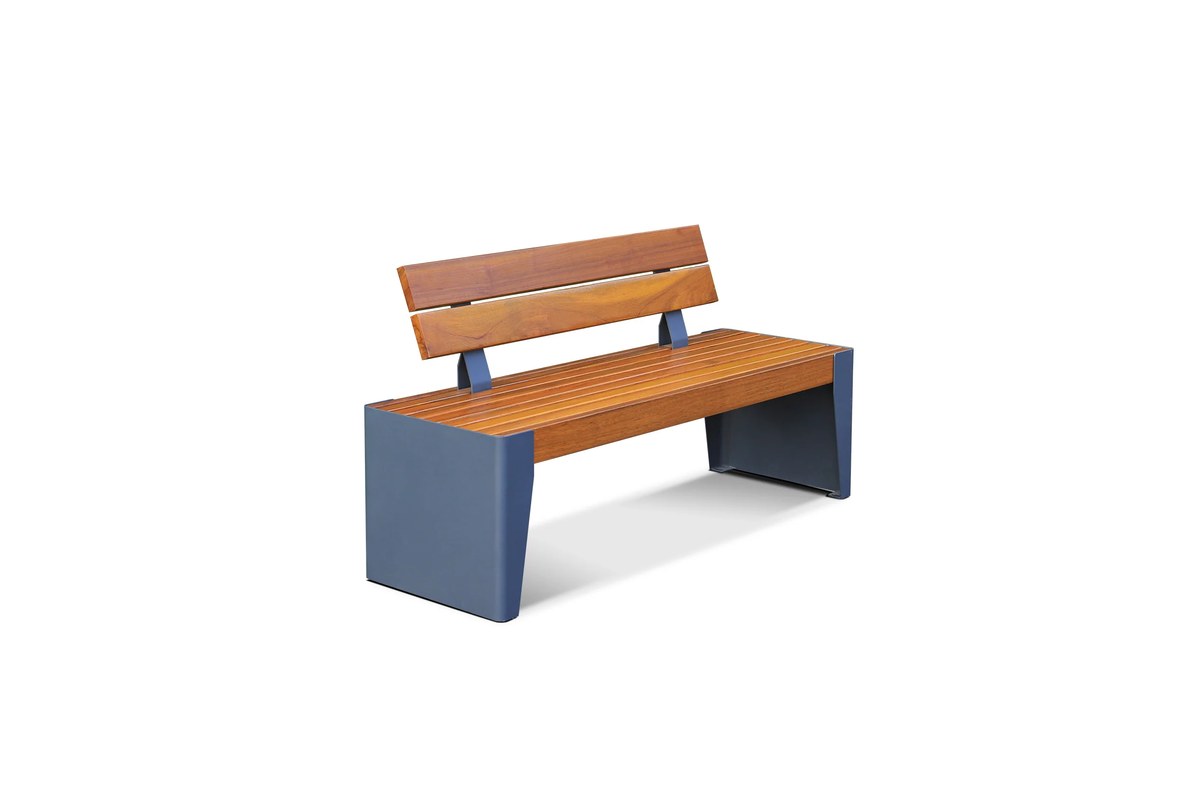
In-ground installs follow the same logic with one extra stage: legs or an extended frame section are set in an excavated hole and concreted in, with the concrete allowed to cure before the bench takes load. The bench leaves the factory ready for whichever method you specify — but it is worth deciding before ordering, because the feet differ.
What keeps the fixings themselves safe?
An anchored bench can still be undone one screw at a time. Public sites need fasteners that need a dedicated tool to remove — the standard approach is a set of anti-theft fixings on every base plate and slat, with one matching driver kept per maintenance vehicle rather than issued to everyone. On exposed or coastal sites, stainless fasteners and periodically re-checked torque are worth specifying up front; our note on coastal rust-proofing covers what salt air does to ordinary hardware.
Anchoring also interacts with placement. A bench bolted to a perfectly sound base can still create hazards if it sits where people run or where the ground pools water — considerations we cover in the guide to choosing benches for high-traffic plazas. If you are planning an installation programme and want the fixing method confirmed against your surfaces before ordering, send us the site details, or browse the projects page to see the bench families and their base options.
Frequently asked questions
- How do you fix a park bench to concrete?
- Position the bench, mark through the pre-drilled holes in its feet, drill and clean holes to the anchor specification, then set expansion or sleeve anchors through the base plates, torque them down and fit the protective caps. A two-person crew completes a standard surface-mounted installation on concrete in about an hour.
- Can a park bench be installed without concrete?
- Not directly on soil or grass - the bench will move as the ground softens. The standard solution is an in-ground fixing: the legs or extended frame are set in a concrete footing below frost depth, which anchors the bench even in soft ground. On timber decking, benches can be bolted through the feet into the structural bearers.
- How do you stop park benches from being stolen or moved?
- Anchor the bench with through-bolts into concrete or an in-ground footing, and secure those fasteners with anti-theft socket screws that require a dedicated driver. A properly anchored bench with protected fixings cannot be carried off or undone with ordinary tools, which removes both opportunistic theft and casual relocation.
Need benches specified with the right fixing method for your surfaces? Send us the site plan.
Get a quote