
At a glance
- Treat street planters as furniture with a traffic role: continuous runs define edges, isolated pots only decorate.
- Bodies roughly 500 mm high or more, in steel and filled with soil, carry real mass and cannot be shifted casually.
- Keep a clear walking corridor, delivery gaps and sightlines to shopfronts — protection that blocks trade fails both tests.
- Galvanised steel with outdoor powder coating, drainage holes and ground-fixing options survives street cleaning and winter salt.
Why use planters instead of bollards on a shopping street?
Because a shopping street has to solve two problems at once, and a row of bare bollards only solves one. Traders and street managers want the pavement edge to feel like part of the shop, while still making it obvious that vehicles do not belong on the walking surface. Steel planters do both jobs in one element: the mass and continuity of a run of bodies performs the separating role, while the planting softens what would otherwise look like a barrier installed against the public.
There is a behavioural bonus as well. Bollards read as barriers; planters invite people to walk alongside them, look at the planting and, when combined with benches, to stay. One boundary matters in specification: a planter line deters casual and accidental vehicle movement, but it is not an engineered anti-ram device. Where a threat assessment calls for certified vehicle security, the planters should complement — not replace — bollards or barriers tested for that purpose. Within that boundary, steel outdoor planters remain the most versatile edge element a shopping street can specify.
What size and weight do protective planters need?
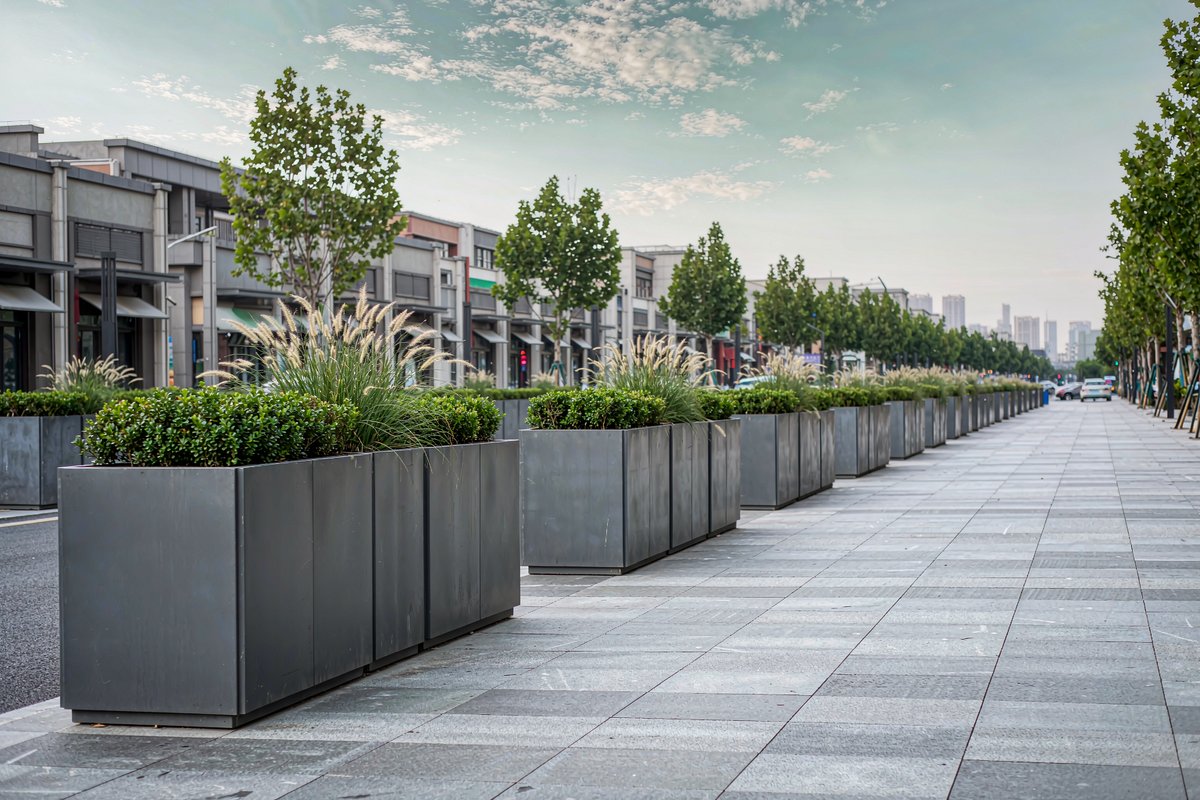
Scale is what turns a pot into an edge. As a starting point, protective runs use bodies from roughly 500 mm high — enough to read as a boundary from a driver's eye level — and rectangular forms that can be placed end to end. Weight does the quiet work: a steel body filled with wet soil and shrubs quickly reaches a mass that two people cannot shift without equipment, which is why street planters disappear far less often than light decorative pots. For a full comparison of how the different street roles map to sizes, see the table below.

How should planters be arranged so they protect without blocking trade?
The arrangement rules matter more than the product choice. A continuous line with small overlaps between bodies leaves no convenient gaps for a car nose, while a dotted line of separated pots invites drivers to nose between them. Three clearances must be respected at the same time: a walking corridor generous enough for two prams to pass; marked gaps for deliveries, bus stops and emergency access that can be planned rather than improvised; and sightlines to shopfronts and signage, because a planter that hides a storefront is a planter the trader will lobby to remove.
| Planter role | Typical size and form | Arrangement notes for streets |
|---|---|---|
| Edge definition and separation | Rectangular steel bodies, ~500 mm high and above, placed end to end | Continuous runs with small overlaps; keep the line honest — few or no gaps |
| Discouraging casual parking | Large bodies with shrub or small-tree planting, ground-fixed where possible | Position on the kerb line at kerb-side corners; not a substitute for certified anti-ram barriers |
| Greening and amenity | Square or round bodies, 450–600 mm high, some with seating rims | Cluster at crossings and rest points with benches and litter bins nearby |
Pairing planters with seating is where shopping streets win back their dwell time. A planter cluster beside a bench defines a small "room" on the pavement, gives pedestrians a reason to stop rather than pass through, and shelters the seat from the kerb side. The same dwell-point logic that governs seating intervals is covered in how far apart park benches should be placed, and it transfers directly to street layout.
Which materials and fixings survive a street environment?
A shopping street is a harsher environment than a park: sweeping machines, trolleys, de-icing salt, summer heat on dark surfaces and constant casual contact. Galvanised steel with an outdoor powder coating is the workhorse specification — the zinc layer under the coating means a scratch does not become a rust streak down the body, and the coating carries any colour the streetscape palette needs. Stainless steel bodies suit premium streets and coastal frontages; hardwood-clad planters warm up older streetscapes but commit the client to an oiling cycle.
Three details are easy to miss and expensive to retrofit. Drainage holes with a free-draining base layer prevent waterlogged root balls after every storm. Ground-fixing plates allow the units to be bolted down at vulnerable corners — usually the kerb-side ends of a run — while keeping the rest of the line movable for events and cleaning. And internal soil volume should be matched to the planting plan: street trees and large shrubs need depths that small decorative bodies cannot provide. For schemes that also need bins and seating from the same family, our park benches and seating and outdoor litter bins share the same steel and coating systems, so the whole streetscape ages uniformly.
Specifying street planters with LVEN
Hunan Lven Urban Furniture Co., Ltd. has produced urban public furniture since 2012 across three bases in Changsha, Jinhua and Foshan — more than 20,000 m² of production space, over 410 patents and supply to projects in 60+ countries. Our planter range runs from compact square bodies for entrance greening to large rectangular street units with ground-fixing plates, in powder-coated steel, stainless steel and hardwood-clad options, with drainage, liners and planting details matched to your landscape plan.
If you are planning a streetscape upgrade and want planter sizes, fixing points and clearances checked against your street cross-section, send us the drawings. We will return a specification proposal before anything is manufactured.
Frequently asked questions
- What size planter do you need to stop cars parking on the pavement?
- A continuous line of large, heavy or ground-fixed planters — bodies roughly 500 mm high or more, weighing several hundred kilograms once filled with soil and shrubs — discourages casual parking and clearly defines the pedestrian edge. For sites with certified vehicle-security requirements, planters are not a substitute: specify engineered bollards or barriers designed and tested for that purpose.
- How do you stop street planters from being moved or stolen?
- Mass comes first: a steel body filled with soil weighs far more than one person can shift. Where extra security is needed, planters can be bolted to the pavement through base plates, specified with anti-theft fixings on service parts, and grouped so that moving one would be noticed immediately.
- What plants are best for low-maintenance street planters?
- Tough, wind- and drought-tolerant species that keep their shape between pruning rounds — evergreen shrubs, ornamental grasses and hardy groundcovers are the street default. The planter needs enough soil depth for the species chosen, drainage holes, and a volume that does not dry out within a day in summer.
Need this specified for your own site? Send us the scene, quantity and finish requirements.
Get a quote