
At a glance
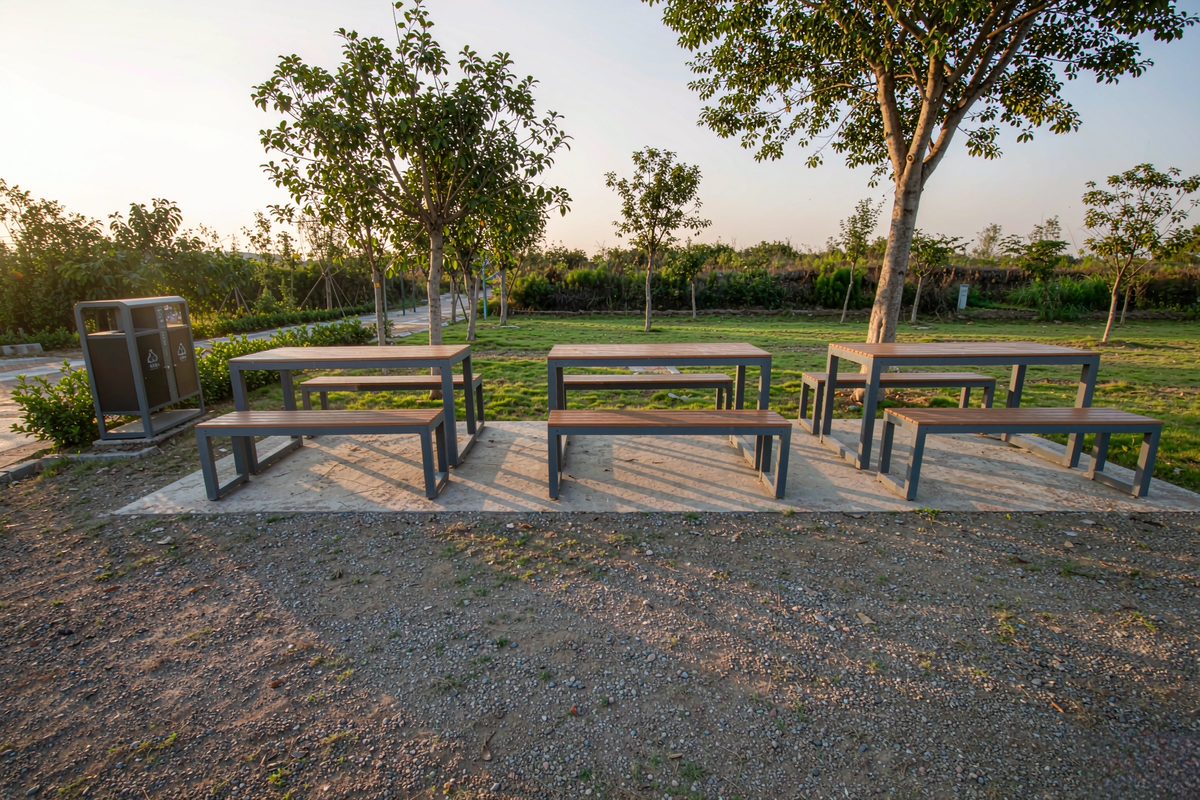
- Size the area from peak-hour picnickers: one 1.8 m table with attached benches seats 6–8 adults.
- Keep 1.2 m of clear circulation around every table and about 3 m between table edges.
- Place paired litter and recycling bins at the entrance and every 25–30 m — never hidden behind tables.
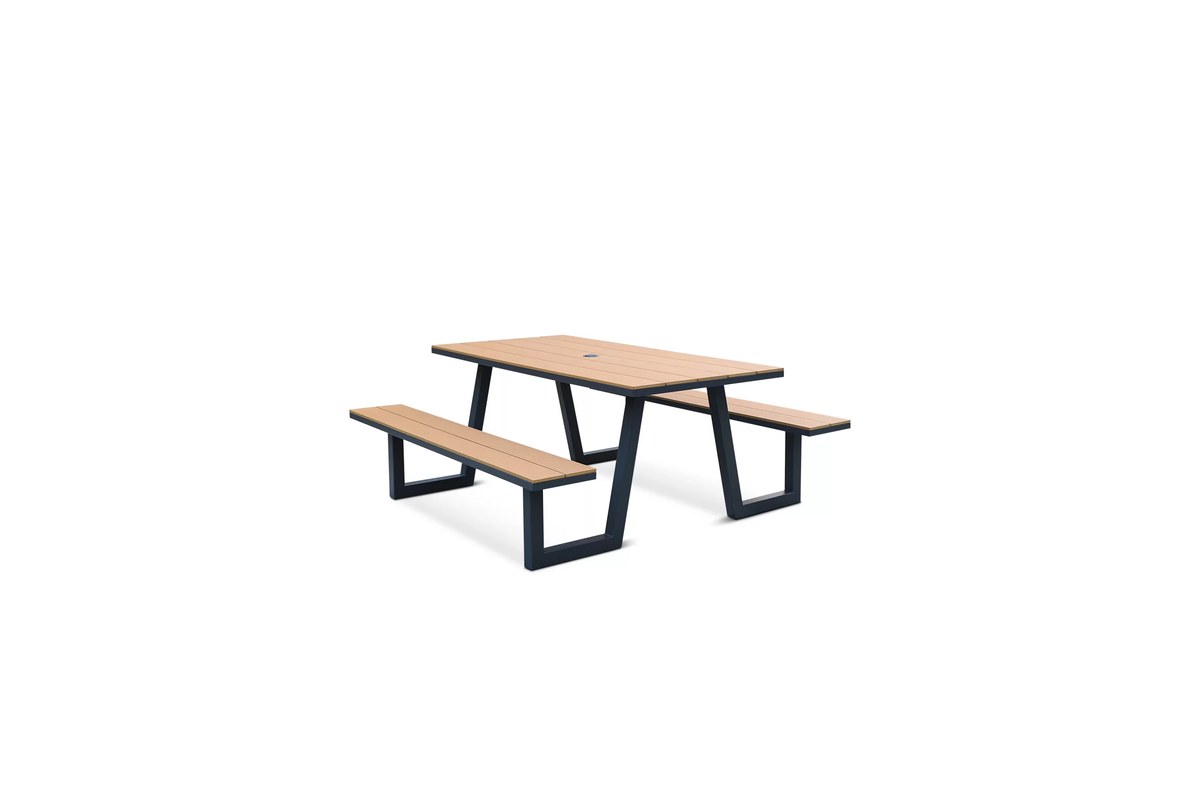
- Spec steel frames with outdoor powder coating and HDPE or hardwood slats for public use.
How many picnic tables does a picnic area actually need?
Start from observed demand, not from the site area. Estimate peak visitors, multiply by the share who will sit down to eat, and divide by seats per table. If a park sees 150 visitors at the Sunday peak and roughly 40% stop to eat, that is 60 diners; at 6–8 seats per standard table you need 8–10 tables. Keep the estimate conservative because tables turn over slowly — families hold a table for one to two hours, much longer than people occupy a bench.
Then split the count across the site. A single dense cluster works for a small park picnic lawn; for a riverside greenway or a large recreation ground, repeat small clusters of 2–3 tables at each destination (shade, playground edge, water access) instead of one central block. Public project references show that clusters at destinations are used far more evenly than one big field of tables, and mowing and cleaning routes stay simpler.
How far apart should picnic tables be placed?
Three numbers do most of the work. First, 1.2 m of clear space around every table: enough for someone to push back a bench and stand up, and enough for a wheelchair to approach the end of the tabletop. Second, about 3 m edge-to-edge between tables so a wheelchair or stroller can pass between occupied tables without squeezing through personal space. Third, no service gap smaller than what your maintenance vehicles need — a ride-on mower or a litter-collection cart needs a straight run between clusters.
Where the site allows it, align tables in short rows rather than scattering them at angles. Rows read as "public" and stay tidier; scattered layouts read as private space and collect more litter in the gaps. The same behavioural logic applies to seating elsewhere in the park — how far apart park benches should be placed follows the walk-time between destinations, and picnic clusters respond to the same pattern.
Where should litter bins go in a picnic area?
Picnic areas generate waste at the table, but bins belong at the edges people already cross. Put one paired litter and recycling station at the entrance, where nearly every visitor passes twice, and repeat a station every 25–30 m along the seating edge. Behind-the-table bins are the classic mistake: they fill slowly, overflow silently and get bypassed. If the area includes grills or a food kiosk, add a station beside them and consider an ash column for smokers nearby so charcoal and cigarette ends stay out of the general waste stream.
Match the bin count to the emptying round, not to a one-size number. Two streams — recyclables and general waste — cover most picnic sites; 2-bin, 3-bin and 4-bin layouts suit different stream counts. Choose outdoor litter bins with lockable access doors and liner handles so the round is quick, and keep the collection route off the dining pads — a cart crossing between occupied tables is the fastest way to make visitors move elsewhere.
Which picnic table specification survives outdoors?
Public picnic furniture fails on the frame and the fixings long before the top wears out. Compare the three specifications we see most often in parks:
| Specification | Upkeep | Best fit |
|---|---|---|
| Steel frame, outdoor powder coating + HDPE slats | Hose down; individual slats replaceable on site | High-traffic city parks and playground edges |
| Galvanised steel + thick powder-coated top | Wipe down; recoat deep scratches | Lakesides, coastal picnic sites, plazas |
| Steel frame + hardwood slats (merbau or teak) | Oil slats yearly; replace slats individually | Scenic and heritage sites where the look matters |
Whatever the finish, prefer one-piece picnic tables and chairs with attached benches for public sites. Loose chairs give flexibility on a campus but migrate, stack and disappear in a park; welded bench-tables hold the layout you designed.
How do you prepare the ground and fixings?
Set tables on a concrete or compacted gravel pad with a 1–2% fall so rain runs off instead of pooling under benches. On concrete, expansion anchor bolts are enough; along grass edges or unmade ground, use in-ground embedment so the frame cannot be rocked loose. Add anti-theft fixings to access doors, liners and slats — the parts most often removed. Because we manufacture the frames as well as the fixings, LVEN can match anchor and embedment sets to the specific table model; send the site drawings through our contact page and we will return the fixing plan with the quotation.
One last check before ordering: walk the route an emptying cart will take from every bin station to the gate. If the layout makes that route long or blocked, no bin count will keep the site clean.
Frequently asked questions
- How many people fit at a standard picnic table?
- A 1.8 m picnic table with attached side benches seats 6–8 adults comfortably; a 1.5 m table seats 4–6. For mixed groups, plan on 6 people per table when sizing a new picnic area.
- Should public picnic tables be fixed to the ground?
- Yes, in any public park. Fix tables with expansion anchor bolts into a concrete pad, or use in-ground embedment on grass edges. Anti-theft fixings on access doors and slats prevent the most common forms of vandalism.
- How much space should I allow per picnic table?
- Allow roughly 3 m × 4.5 m per table including clear circulation on all sides, plus extra end space where wheelchair users need to pull up to the tabletop.
Need this specified for your own site? Send us the scene, quantity and finish requirements.
Get a quote