
At a glance
- Armrests are a usability feature first: they give hands something to push against when standing up.
- A divider does a different job - it splits a long seat into places and changes how the bench is used.
- Arms add depth as well as cost: LVEN's armrest benches are 64.5-69 cm deep, against 50 cm for the plain OTY-42.
- Decide arms and dividers with the bench length - each divider removes a sitting place.
What do armrests do on a public bench?
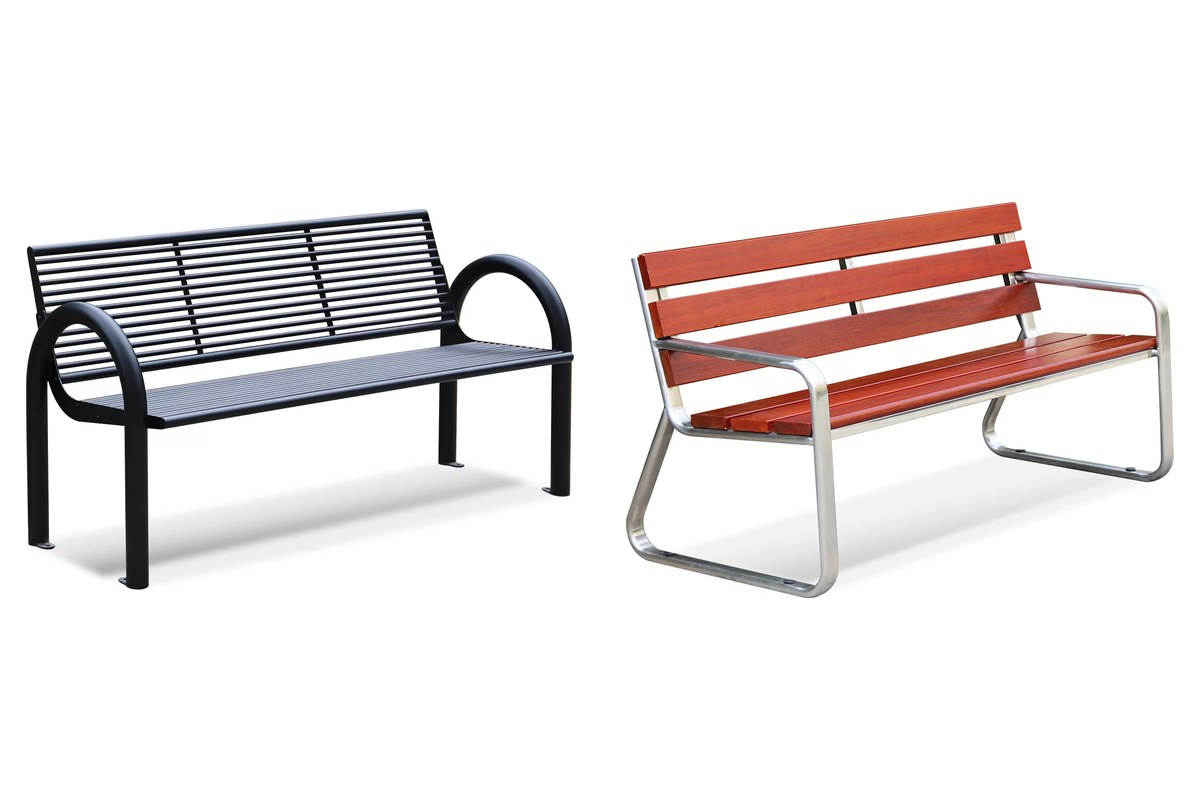
On paper an armrest is a short steel tube. On a bench it does four jobs at once. It gives a seated person something to push against when standing up, which matters to older visitors and anyone with a knee or hip problem. It gives the forearms somewhere to rest. It marks the end of a sitting place, so a stranger does not slide into your shoulder. And it keeps bags and wet umbrellas off the slats.
That explains why one bench family is often ordered in two versions: a promenade where people stop for twenty minutes benefits from arms, a grass edge where families sit sideways does not. The LVEN bench range covers both, from the OTY-25A and OTY-68 to the plain OTY-42.
Do armrests make a bench more accessible?
For many visitors, yes - which is the strongest argument for specifying them. Accessible seating guidance in many markets recommends armrests because they turn a seat into something a person can leave without help; without arms, a visitor with limited mobility must pull on the backrest or push off the seat edge.
Two details decide whether the benefit is real: the arms should let a hand grip them with the forearm roughly level, and they must take a person's weight through one hand, repeatedly, for years. Both come down to the frame: a welded steel loop such as the OTY-25A's differs sharply from a thin tube bolted onto slats. Our notes on park bench seat height and designing outdoor furniture for accessibility follow the same order - seat height first, then arm height, then length.
What is the difference between an armrest and a centre divider?
An armrest sits at the end of a bench, or at each end. A divider sits in the middle and splits one long seat into two or three places. From a distance they look alike; in use they are not.
Dividers are usually specified where a long bench would otherwise be taken over by one person lying down - transit stops at night, hospital forecourts, shopping streets after closing. They work, and they change the character of the place: a bench with three dividers reads as three chairs, and a group of four friends will sit elsewhere. That is a design decision rather than a technical one.
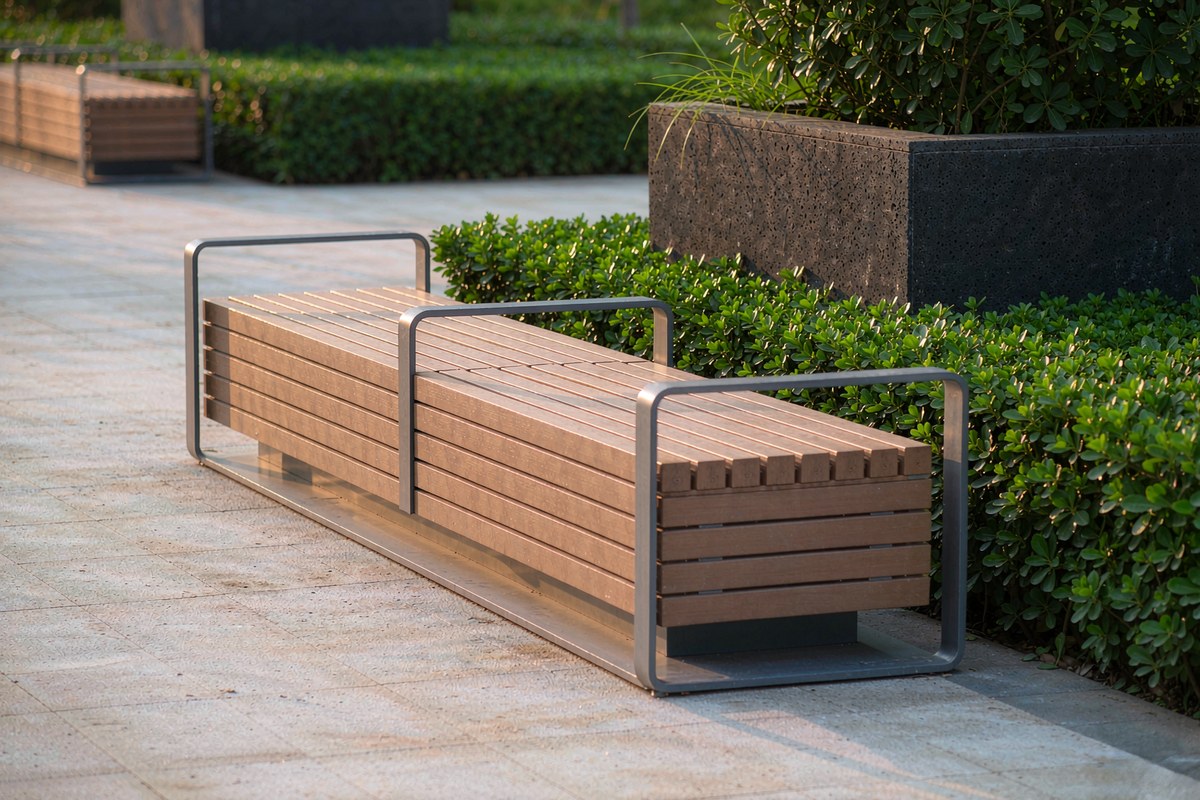
Most projects choose the middle ground: end arms only, on 150-180 cm benches - support and a visual boundary, without the row-of-chairs effect.
How much bench do you lose when you add arms?
Every arm consumes length and, less obviously, depth. An arm needs a frame member beside the sitter, so armrest benches are wider: the OTY-25A is 64.5 cm deep and the OTY-68 is 69 cm, against 50 cm for the armless OTY-42. On a narrow footpath that 14.5-19 cm decides whether the bench fits without pushing pedestrians onto the grass.
Length matters too. A 150 cm bench with two end arms seats two adults comfortably and three only if they are children; the same length without arms takes three adults happy to touch shoulders. If the brief says "seat three", start from the armless families or move up to 180 cm.
| Model | Length x depth x height | Frame and slats | Armrest / divider |
|---|---|---|---|
| OTY-25A | 163 or 200 x 64.5 x 83 cm | Carbon steel frame, galvanized steel slats | Carbon steel arms at both ends |
| OTY-25D | 180 x 64.5 x 83 cm | Carbon steel frame, perforated galvanized seat | Carbon steel arms at both ends |
| OTY-25E | 163 x 64.5 x 83 cm | Galvanized steel frame, WPC slats | Curved armrest design |
| OTY-68 | 150 or 180 x 69 x 80 cm | Stainless steel frame, Jatoba slats | Integrated armrests |
| OTY-42 | 150 or 180 x 50 x 78 cm | Galvanized or stainless steel, timber slats | None |
| OTD-42 | 150 or 180 x 45 x 45 cm | Galvanized or stainless steel, Jatoba or pine | None (backless) |
Which armrest details fail first on site?
Three details fail first. A flat arm top collects water and leaf litter, and the powder coating lifts from the inside out - arms that slope, or that form an open loop, shed water instead. The joint where the arm meets the frame comes second: people lean on an arm and occasionally stand on it, so a joint that looks fine in a rendering can fatigue. The third is heat: a dark powder-coated arm in summer sun becomes uncomfortable within seconds, which is why timber-capped arms feel better.
Skip arms where the bench is really a ledge: a low backless seat along a planter, a grass edge in a picnic area, a viewpoint where people sit sideways - and where the seat must absorb a crowd. The spacing rules in how far apart should park benches be placed assume a bench footprint, and arms widen it, so add the depth difference before counting how many benches fit.
What should an armrest specification include?
- Position - both ends, one end, or ends plus one or two dividers.
- Height - arm top above the seat, checked against the seat height on the same drawing.
- Construction - welded loop, cast aluminium or integrated frame, with wall thickness and joint type.
- Finish - powder coat colour and gloss, plus a touch-up pen.
- Fixings - how the arm is attached, and whether the bench ships knocked down.
If you have the layout and a picture of who will use the seat, send both through the contact page and we will propose two or three models with and without arms, plus matching litter bins. See the project gallery.
Frequently asked questions
- Do park benches need armrests?
- They are worth specifying wherever older visitors, patients or anyone with limited mobility will sit. Armrests give a hand something to push against when standing up, which a backrest alone cannot do. The trade-offs are a wider footprint - 64.5-69 cm on LVEN's armrest models against 50 cm on the armless OTY-42 - and a slightly higher unit cost.
- How wide is a park bench with armrests?
- Expect 64.5-69 cm of depth on a steel or stainless frame, because the arm needs its own frame member beside the sitter. The OTY-25A and OTY-25E measure 64.5 cm deep and the OTY-68 measures 69 cm, all with a seat height of 80-83 cm overall. Plain benches without arms are narrower: the OTY-42 is 50 cm and the backless OTD-42 is 45 cm.
- Can armrests be added to an existing bench later?
- Rarely, and usually not worth it. On welded frames the arm is part of the structure, so retrofitting means drilling and bolting into a finished, powder-coated frame - a joint that is hard to seal and easy to loosen. It is far cheaper to choose an armrest model at order stage, or to accept a bench without arms in the zones where they matter least.
Choosing between bench families? Send the layout and expected users, and we will propose models with and without armrests.
Get a quote