
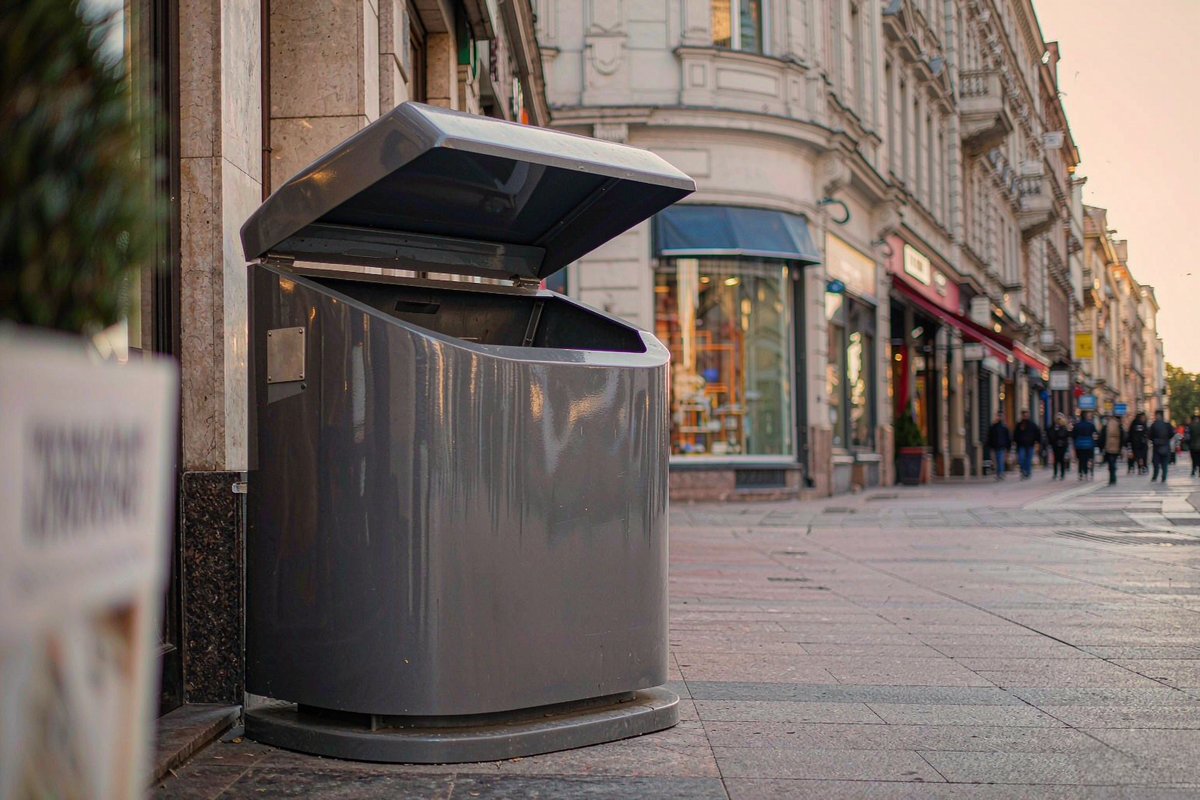
At a glance
- People dispose of waste in one motion without looking - the opening must accept the street's dominant items (cups, bottles, food bags) without aiming.
- For general litter in pedestrian zones, a clear opening of about 220-300 mm wide is the practical starting point.
- Use narrow slots (80-120 mm) and small holes only on recycling, cigarette and dog-waste positions where the stream is defined.
- An opening is only right if the liner behind it matches - check liner mouth, hood overhang and emptying frequency as one system.
Why does bin opening size matter so much in pedestrian zones?
Street waste is created on the move. Someone finishing a coffee at a crossing has maybe two seconds and zero patience: they drop the cup in the direction of the hole and keep walking. If the opening forces aiming, twisting or a second attempt, the cup lands on the hood, wedged in the aperture or on the pavement. Overflow that operators blame on capacity is very often a disposal-friction problem - a full-looking hood on a bin whose liner is barely half used.
Opening size also sets what the bin quietly refuses. A generous opening accepts everything a street produces; a slot-sized opening filters. Filtering is exactly what you want on a recycling pair - it forces a pause and improves stream quality - and exactly what you don't want on a general bin in a shopping street, where "wrong" waste has nowhere else to go. So the first specification question is not "how big?" but "what is this bin supposed to catch?"
Which opening shapes and dimensions work in practice?
Public bins fall into a small number of opening families, each suited to a different job. The dimensions below are common industry practice for clear apertures - the usable hole after hoods, flaps and liner edges are accounted for - rather than absolute standards; individual models vary, so always check the clear size on the drawing.
| Opening type | Typical clear size | Best suited to |
|---|---|---|
| Wide rectangular | 220-300 mm wide × 150-200 mm deep | General litter on high streets, transit stops and plazas - cups and takeaway bags pass in one motion |
| Round, hooded | 150-200 mm diameter | Parks and gardens - balanced one-hand disposal with better rain and bird protection |
| Narrow slot | 80-120 mm | Recycling streams (bottles, cans, paper) and combined ash/litter tops where the stream is defined |
Two combinations cover most pedestrian-zone programmes: a general bin with a wide rectangular opening, paired with a recycling position using slots. Where smoking concentrates - outside offices, transit shelters, bar fronts - add a dedicated ash position or an ash column for smoking zones rather than shrinking the general opening, which never stops cigarette butts anyway.
How do you match the opening to liner size and emptying routine?
The opening and the liner must agree. A frequent mismatch is a wide decorative aperture sitting above a liner whose mouth is narrower, or pushed so deep inside the body that waste lands between liner and shell. As a check: the liner mouth should meet or slightly exceed the clear opening width, and the liner rim should sit within reach of the aperture so nothing catches on the way down.
Capacity then decides whether the opening helps or hurts. A 50-70 litre liner is the workhorse size for high-street bins; with a wide opening it fills fast at peak times, which is the honest trade - a bin that is easy to use fills faster and needs more frequent rounds. Our calculation method for park bin counts shows how to size quantities against emptying frequency; the same arithmetic applies to shopping streets, where a larger liner or an extra position usually beats "solving" overflow with a bigger hole on the same small body. For sorted stations, the layout logic in our 2-bin vs 3-bin vs 4-bin guide pairs each stream with the opening style it needs.
Which details make an opening easier to live with on site?
Four details do most of the work. First, a hood or roof over the aperture: it keeps rain out of the liner, adds bird protection and reads as a target from a distance. Second, a hood angle that discourages perching waste on top - steep enough that cups slide off rather than stack. Third, materials that survive constant hand contact around the aperture: powder-coated steel is the everyday choice, while 304 stainless around the opening is worth considering where cleaning frequency is high - the trade-offs are set out in our stainless vs powder-coated comparison. Fourth, a side or front door wide enough to lift the liner out straight, because a perfect aperture on a bin that crews hate emptying is still a failed specification.
Browse the aperture styles above in our outdoor litter bins range, or see them specified in finished schemes on our projects page. If you are sizing bins for a pedestrian zone, send us the foot-traffic pattern and waste streams - we will suggest opening types, liner sizes and a placement plan to match.
Frequently asked questions
- What is the standard opening size for a public litter bin?
- Most general-waste street bins use a clear opening roughly 220-300 mm wide and 150-200 mm deep - large enough for a coffee cup or takeaway bag to pass in one motion, small enough to keep rain and oversized household waste out. Narrower slots are reserved for recycling and cigarette positions.
- Do smaller openings actually reduce wrong disposal?
- Yes, but only for sorted streams. A 80-120 mm slot persuades people to think before they drop, which improves recycling quality. On a general-waste bin the same slot backfires: waste lands on the hood and around the bin, so openings below about 150 mm should only be used where the stream is well defined.
- How large should a bin opening be for a shopping street?
- Size the opening around the dominant waste - typically coffee cups, drink bottles and food packaging - so a wide rectangular or generously round opening of 220-300 mm works for most high streets. Pair it with a 50-70 litre liner and an emptying round matched to peak foot traffic.
Sizing bins for a street or plaza? Send us the waste streams and emptying routine.
Get a quote