
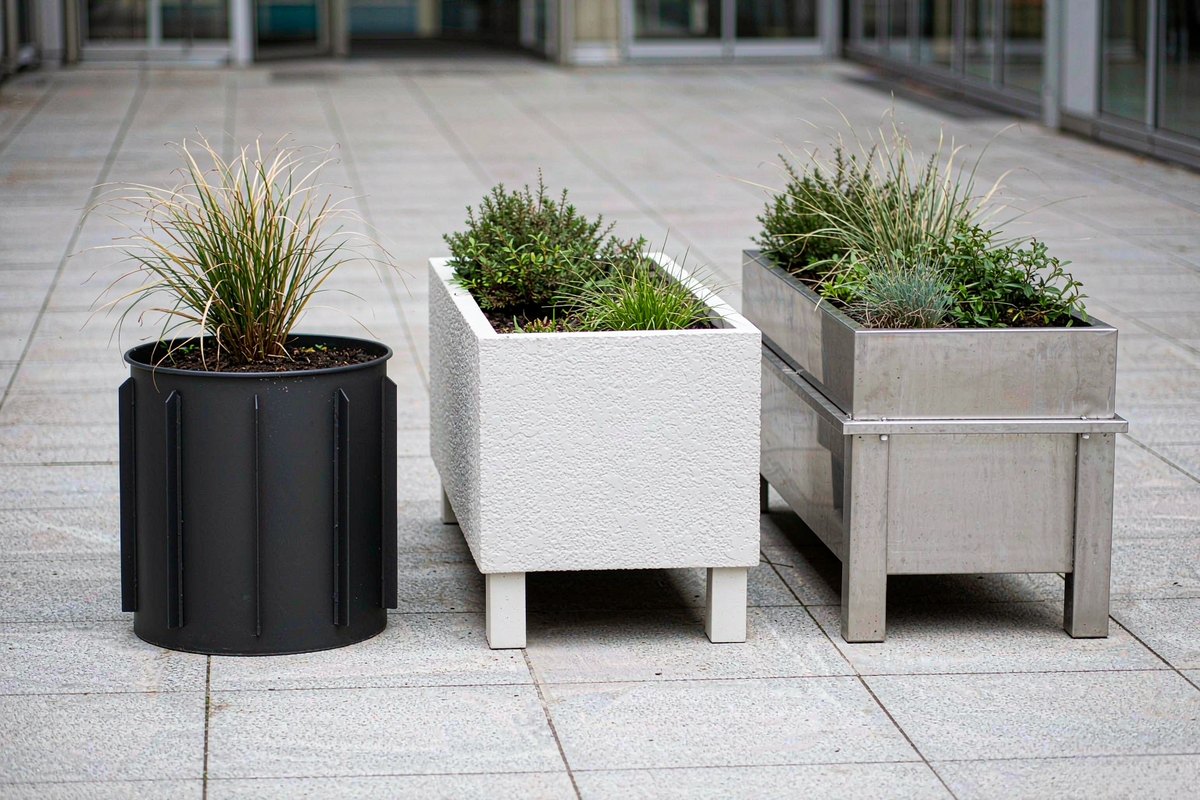
At a glance
- Powder-coated galvanized steel is the general-purpose choice: OTHP-04 comes in three sizes from 30 × 30 cm to 35 × 70 cm, and OTLB-32 reaches 100 cm diameter by 120 cm high.
- Aluminum is the lightest of the three. OTLB-11 and OTLB-12 both come in 120 × 40 × 50 cm and 80 × 50 × 70 cm formats, with a stone-texture or slatted finish.
- Stainless steel is chosen where appearance and cleaning dominate: OTLB-04 in brushed stainless at 120 × 30 × 60 cm, OTLB-06 with a stone-texture powder coat.
- The metal changes the corrosion path, the load on the slab and the repair method - not the planting depth.
What are the three options in practice?
Galvanized steel is mild steel dipped in molten zinc. The zinc acts as a barrier, and keeps protecting cut edges and drill holes where the coating is broken, because zinc corrodes before steel does. A powder coat goes on top for colour and a uniform surface. This is the construction behind the OTHP-04 cylinder, the tapered OTLB-23 and the ribbed OTLB-32.
Aluminum does not rust in the ferrous sense: it forms a thin oxide skin that re-forms when scratched. At roughly a third of the density of steel, a long box such as the 120 × 40 × 50 cm OTLB-12 can be repositioned by two people. The trade-off is stiffness, so aluminum planters need folded edges and internal returns to feel solid at the rim.
Stainless steel carries chromium, and 304 grade enough nickel, to hold a passive layer that resists water and chlorides. It is used brushed, as on the 120 × 30 × 60 cm OTLB-04, or with a textured powder coat, as on OTLB-06. The 201 versus 304 comparison explains when the cheaper grade is defensible.
Which one handles weather and salt?
Inland, all three work; the difference appears at damage points. A galvanized planter that loses its powder coat to a trolley strike still has zinc underneath, while a painted aluminum planter at the same spot exposes bare metal that will oxidise but not bleed rust onto paving. Powder-coated surfaces in all three cases chalk and fade under UV before they fail structurally, which is why the coating system matters as much as the substrate - see our powder coating versus fluorocarbon guide.
Salt changes the ranking. Near the sea, chlorides attack zinc and 201 stainless quickly and pit aluminum wherever the coating is breached. For a coastal promenade, 304 stainless or a well-detailed aluminum box with isolated stainless fixings is the safer specification. Our coastal rust-proofing checklist covers the detail level that decides service life.
How much does weight matter?
Planting medium is heavy, so the empty weight of the box is only part of the load - but it sets how the planter is handled before filling: delivered, walked into position, aligned, planted. A 180 cm long OTLB-17 in galvanized steel needs machine help; a comparable aluminum box often does not.
On podium decks and roof terraces every kilogram counts against the structural allowance, and tall units such as the 120 cm high OTLB-32 need a wind check as well as a dead-load check - an empty cylinder is a sail. Base fixing or ballast solves it, but the decision belongs at design stage.
How do they compare on maintenance?
Galvanized steel is the most forgiving to repair: a matching touch-up aerosol deals with most chips, and the zinc below keeps working. Aluminum needs the bare metal primed first, otherwise the coating lifts. Stainless is easiest to wash and hardest to disguise - brushed surfaces hide fingerprints, but scratches cross the grain visibly.
Cleaning chemistry barely differs. Stainless and powder-coated steel both tolerate mild detergent and water, and abrasive pads should stay away from both. Where graffiti is recurring, the smoother the finish the better it cleans, which is one practical argument for stainless in transport interchanges. Our guide to removing graffiti from outdoor furniture lists what is safe on each finish.
Which material suits which project?
Most specifications mix all three on one site, matching the metal to how the planter will be treated rather than to a single house style.
| Setting | Material to start with | Reason | LVEN reference |
|---|---|---|---|
| Inland plaza, park edge, street | Powder-coated galvanized steel | Zinc backup at chips, widest size range | OTHP-04, OTLB-23, OTLB-32 |
| Coastal promenade, marina | 304 stainless, or aluminum with stainless fixings | Chloride tolerance and easy washing | OTLB-04, OTLB-11 |
| Retail frontage, shopping street | Stone-texture aluminum or stainless | Consistent finish across a long run, lighter handling | OTLB-11, OTLB-06 |
| Roof terrace, podium deck | Aluminum | Lowest weight for the same volume | OTLB-12 |
| Seating edge, planter bench | Galvanized steel frame with PS wood seat | Structure from steel, comfort from the seat | OTLB-18A |
| Lobby, indoor atrium | Electroplated stainless | Decorative finish, no weather exposure | OTHJ-01 |
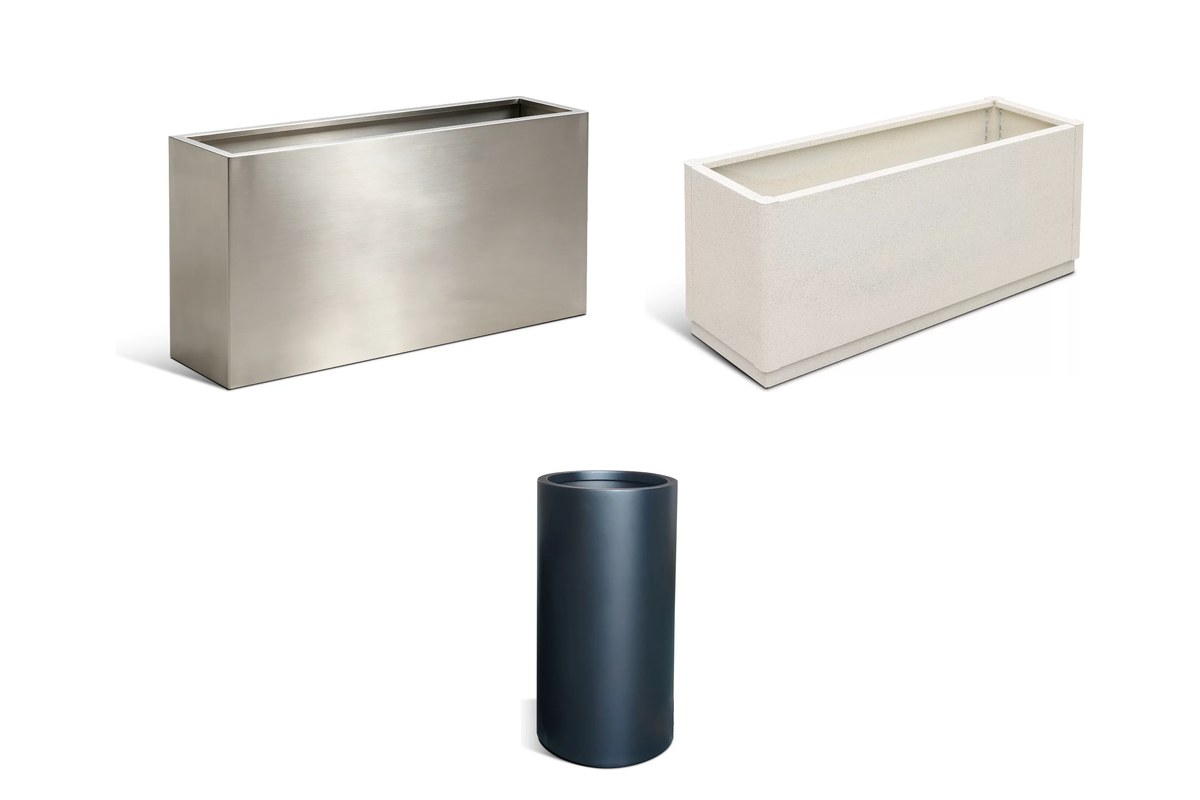
What details decide whether a planter lasts?
Metal choice sets the ceiling; detailing decides whether the planter reaches it. Drainage comes first: water must leave the box, and it must leave below the soil line so the base is not permanently wet. Our planter drainage guide covers hole placement, gravel layers and the mistake of sealing a planter to keep the paving clean.
Second, a liner: it keeps soil acids and fertilizer salts off the metal and lets a crew lift the planting out for replanting without scraping a coated interior. Third, the base - a recessed plinth or small feet lifts the shell off the paving so water drains and a sweeper can pass underneath; the OTLB-11 and OTLB-12 families both use a visible base reveal for this reason.
Then fixing and proportion: tall cylinders and long boxes in exposed positions should be anchored or ballasted, and a planter used as a pedestrian separator needs a minimum size for the job - our planter dimension guide gives the working figures.
Choosing between the three for a live project? Browse the full planter range, or send us the setting and dimensions and we will propose a material, a finish and a planting depth together.
Frequently asked questions
- Is galvanized steel better than aluminum for outdoor planters?
Neither is better in every case. Galvanized steel is stiffer and keeps protecting itself at chips because of the zinc layer, which suits large or exposed planters. Aluminum is much lighter and does not rust, which suits roof terraces and long boxes handled by hand. Both take a powder coat, so the visible finish can be identical.
- Will stainless steel planters rust outdoors?
Stainless steel does not rust the way painted steel does, because the chromium-rich passive layer re-forms when scratched. It can still stain: tea staining and pitting appear where chlorides concentrate - coastal sites, road salt zones, or the soil line inside an unlined box. 304 grade resists this far better than 201, and routine washing with fresh water keeps it clean.
- Do metal planters need a liner and drainage holes?
Yes to drainage, and a liner is strongly recommended. Without drainage, water sits above the base, roots suffocate and the inside of the shell stays wet. A liner separates soil from metal, slows corrosion from fertilizer salts and lets the planting be lifted out for replanting. Even with a liner, the shell needs drainage or a raised base so it never holds standing water.
Specifying planters for a street, campus or waterfront? Tell us the setting and the planting intent and we will match metal, finish and size to it.