
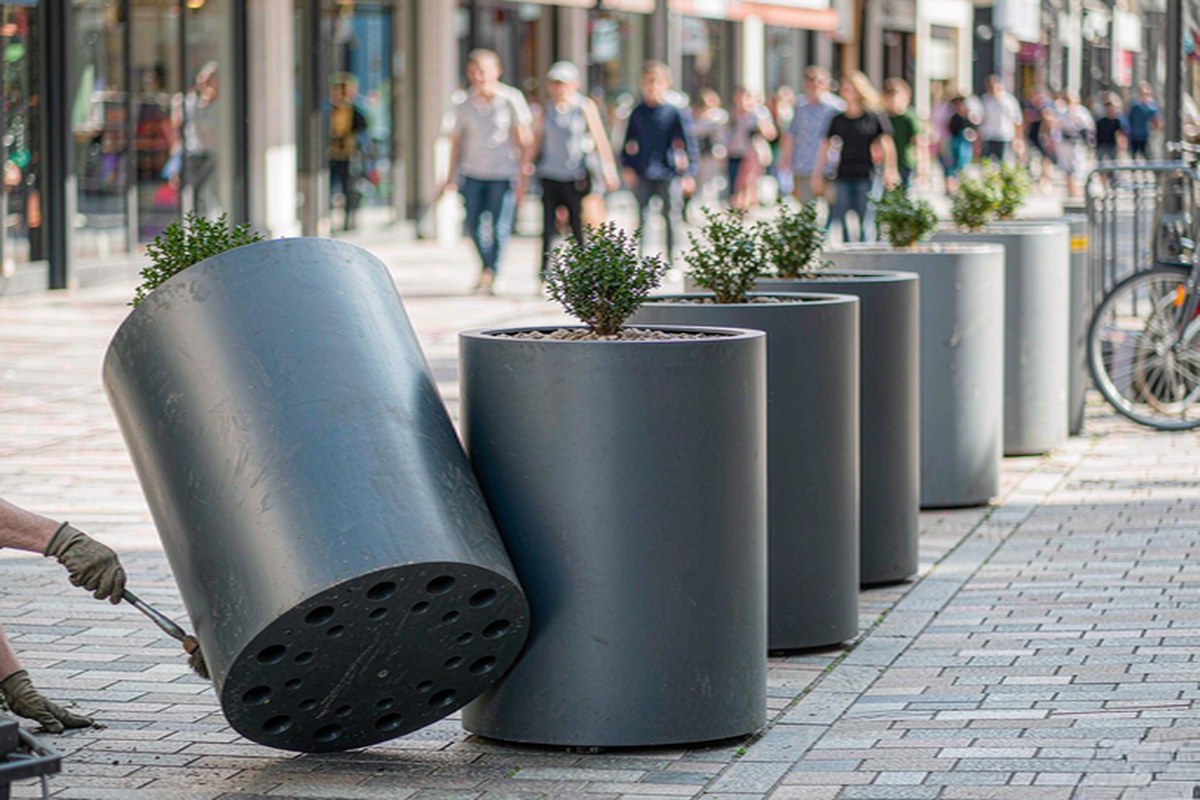
At a glance
- Every planter that lives outdoors needs a path for water to leave — base holes placed to drain, not to clog.
- A drainage layer plus a separation fabric keeps the holes working; the growing substrate matters as much as the holes.
- Feet or standoffs lift the base off the paving, so water escapes and the surface underneath stays clean.
- On rain-exposed sites, an overflow outlet just above substrate level protects roots during cloudbursts.
Why does standing water kill street planters?
Plant roots need oxygen as much as water. When a planter holds a permanent layer of water at its base, the growing medium stays saturated and air is pushed out of the pore spaces; roots suffocate, and the anaerobic conditions that follow invite the root-rot fungi that finish the job. Above ground the symptoms look like a planting problem — yellowing leaves, stunted growth — but below ground it is almost always a drainage problem.
Water that cannot escape also causes damage where you can see it. A planter full of saturated soil weighs far more than a drained one, which matters for any unit on a deck, balcony structure or roof. In climates with frost, trapped water expands as it freezes and pushes against walls and welds season after season. And the mineral-rich water that seeps out over the rim leaves the familiar pale staining on paving — the stain is a symptom of water moving where it should not.
How should an outdoor planter be drained?
Good drainage is a sequence, and the holes are only the first part of it. What works in practice:
- Holes in the base, not the sides. Side holes sit below the soil line once the planter is filled and simply weep against the wall. A pattern of holes across the base — several smaller openings rather than one large one — drains more evenly and is far less likely to be fully blocked by a single stone.
- A drainage layer. A layer of gravel or expanded clay above the holes, deep enough that the substrate above cannot settle into them, keeps the escape route open through the seasons.
- A separation fabric. A sheet of geotextile between the drainage layer and the soil stops fine particles washing down and silting up the base — the most common reason a correctly drilled planter still holds water two years later.
- A free-draining substrate. Structural planting soils drain by design; ordinary garden soil compacted into a tall container behaves like a pot of clay. The medium does half the drainage work before any water reaches the holes.
Get the sequence right and the planter self-regulates: rain enters, excess leaves, and the substrate holds only what the roots can use between rains.
Which planter details keep drainage working for years?
The differences between a planter that stays healthy and one that slowly silts up are usually visible on the spec sheet:
| Construction detail | What it does | Why it matters outdoors |
|---|---|---|
| Feet or standoffs under the base | Creates an air gap between planter and paving | Water leaves freely; the pavement under the unit dries and stays unstained |
| Removable inner liner | Separates planting from the outer shell | Plants can be swapped and the drainage layer flushed without emptying the shell |
| Overflow outlet above substrate level | Provides a second exit during heavy rain | Protects roots in cloudbursts when the base layer is momentarily full |
| Coated interior surfaces | Shields steel from constant interior moisture | The inside of a planter is a wetter environment than its outside |
These are the details we build into our outdoor planters as standard — drainage is decided in the workshop, not improvised on site with a drill after the first failed planting.
Where does drainage fail in real installations?
Most drainage failures we are asked to diagnose are installation habits, not product faults. A planter set flat on smooth paving seals its own base holes; the fix is feet, packers or a gravel bed under the unit. Planters tucked under tree canopies fill with leaf litter that plugs holes from the outside; those sites need the holes checked on the same schedule as the planting. And planters levelled without checking can tilt enough to pool water against one wall — a spirit level at install time prevents a season of soaked plants on one side.
Site layout plays a role too. Sizing and spacing decisions are covered in our guide to planter dimensions for pedestrian separation, and for street schemes the choice of unit itself — liners, heights, planting depth — is set out in our shopping-street planter guide. If you are specifying for a scheme where planters sit alongside park benches and litter bins, our projects page shows how the families work together, and we are happy to review drainage details for your specific surfaces before you order — send us the site conditions.
Frequently asked questions
- Do outdoor planters need drainage holes?
- Yes, and they belong in the base. A planter without drainage holds a permanent layer of saturated soil at the bottom, which starves roots of oxygen and invites root rot. A pattern of smaller holes across the base drains more evenly than one large hole and is harder to block completely.
- What should I put at the bottom of a large outdoor planter?
- A drainage layer of gravel or expanded clay, covered with geotextile fabric before the soil goes in. The layer keeps the base holes open, and the fabric stops fine soil particles washing down and clogging the void. Do not fill the bottom with soil that will compact; the drainage layer plus a free-draining substrate is the combination that keeps working.
- How do I stop outdoor planters staining the pavement?
- Lift the planter off the ground with feet or standoffs so water drains through an air gap instead of seeping out over the rim, and make sure excess water has a downward exit rather than a path through the wall. The pale mineral staining on paving comes from water sitting against the surface; planters that drain from the base onto open paving stay clean.
Need planters specified with the right drainage for your surfaces? Send us the site and planting plan.
Get a quote