
At a glance
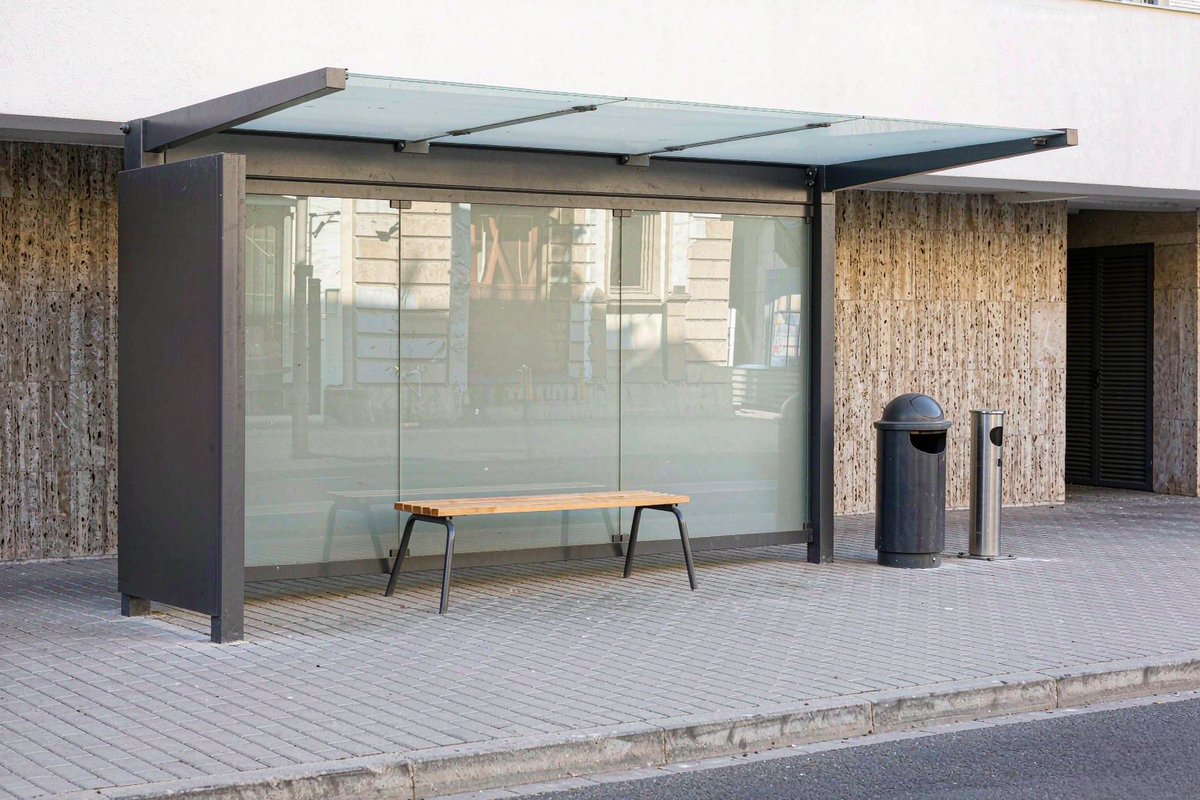
- The working kit for a bus stop is short: bench, litter bin, ash column where needed, and bicycle racks at larger stops.
- Backless benches such as the OTD-42 (only 45 cm deep) fit narrow shelters; OTY-19 (68 cm deep, cast aluminum ends) suits open stops.
- 60 L hooded bins (OTB-14) serve neighborhood stops; 90 L OTB-84 and 40 L × 3 OTB-30 sorting units cover interchanges.
- Anchor bolts, lockable service doors and theft-resistant fixings keep transit furniture where it was installed.
What furniture does a bus stop actually need?
Start from what passengers do while waiting: stand, sit, smoke where permitted, and occasionally throw something away. That yields the core kit - a bench sized to the shelter, a bin placed at the far end from boarding, and an ash column at stops where smoking is common. Everything else is optional and driven by the stop's role in the network.
Placement matters as much as selection. The bench should sit clear of the boarding line so boarding passengers never step over seated ones. The bin belongs at the end of the shelter away from the accessible boarding area, so it never competes for the same space. These decisions cost nothing at planning time and are expensive to fix after installation - our bench placement spacing guide explores the wider principles.
Which bench fits a narrow shelter?
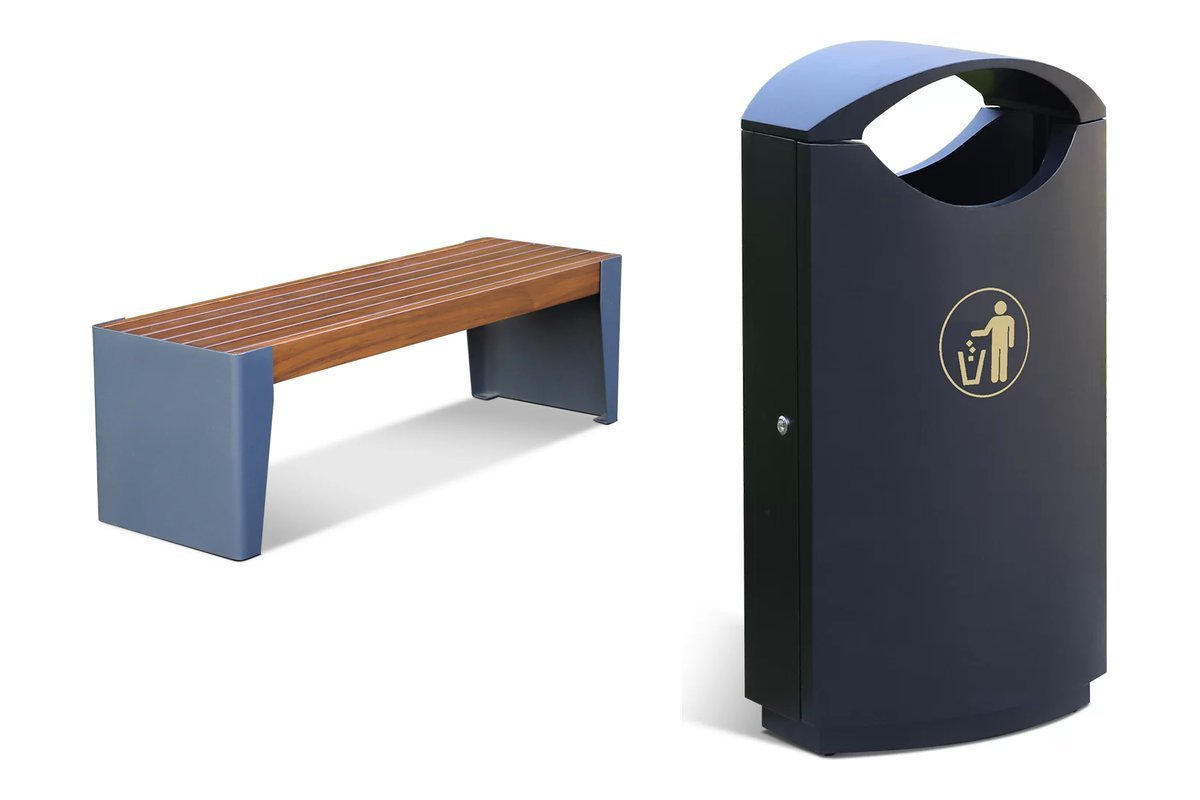
Shelter depth is the constraint that decides bench style. Where the glazing line leaves little room, a backless bench is the practical answer: passengers can use it from either side, and it does not block sightlines to oncoming buses. The LVEN OTD-42 measures just 45 cm deep and 45 cm high, in 150 or 180 cm lengths, with a galvanized steel or stainless steel frame. At that depth it tucks against a rear panel and still leaves a clear walking lane.
Open curbside stops without a shelter can afford a fuller bench with back and arms. The OTY-19 (150 or 180 cm long, 68 cm deep, 80 cm high) pairs timber-look slats with cast aluminum ends, giving a comfortable sit for longer waits while shrugging off weather. Our backrest vs backless comparison walks through the trade-offs in detail, and the 45 cm seat height on both models matches typical ergonomic guidance.
What bin size suits a transit stop?
The honest answer: pick the capacity that survives the longest scheduled gap between collections. A bin that overflows by mid-afternoon turns a tidy stop into a litter source. For neighborhood stops with daily service, the OTB-14 is a strong fit - 60 L capacity in a 50 × 33 × 98 cm body with a hooded opening that keeps rain out of the liner.
Interchange stops that serve several routes collect far more waste, and many transit authorities now require sorting at those hubs. The OTB-84 provides a 90 L hooded single stream with a lockable service door and removable inner liner, while the OTB-30 delivers a 40 L × 3 sorting layout in a 96 cm wide frame - both with pre-drilled base holes and anchor bolts for ground fixing. Custom sorting labels are printable on the OTB-30, which helps passengers sort correctly at speed. Our sorting station layout guide covers matching stream counts to waste profiles.
Should a bus stop include ash columns and bicycle parking?
Where smoking is expected, a slim freestanding column keeps butts out of the bin - which matters more at bus stops than almost anywhere else, because a shelter bin full of smoldering material is a genuine hazard. Our guide on preventing litter bin fires explains that risk in detail. The OTMY-04 (25 × 25 × 113 cm, powder-coated galvanized steel) and OTMY-08 (28 × 28 × 118 cm) both hold a small ground footprint, so they slot between shelter and footway without pinching the walking lane.
Bicycle racks turn a plain stop into a park-and-ride node and cost almost no sidewalk space. LVEN's stainless steel bicycle racks come in three formats - Bicycle Rack 1 at 60 cm wide with an 80 + 30 cm height profile, Bicycle Rack 2 at 60 or 80 cm wide and 90 + 30 cm high, and Bicycle Rack 3 at 93 cm wide and 76.2 cm high - so a row of two or three frames fits against a shelter's side wall. Our bicycle rack spacing guide gives the clearances.
How do you stop transit furniture from moving or disappearing?
Transit stops are unattended public spaces, so every unit should assume rough handling. Ground fixing is the first layer: all the models above ship with pre-drilled base holes and matching anchor bolts, which anchor the furniture into the paving slab. The second layer is hardware: lockable service doors on bins keep liners and contents out of casual reach, and our anti-theft fixings overview covers the fastener options for seats and panels. Combined, these two layers remove the two most common failure modes at stops - units tipping or drifting out of alignment, and parts walking away.
Maintenance closes the loop. Powder-coated galvanized steel surfaces wipe down with standard cleaning agents, removable liners mean the crew never wrestles a full bin on its base, and stainless steel options near food outlets simplify deeper cleaning. Over a network of hundreds of stops, those servicing details decide the true cost of ownership - a theme our quotation comparison guide puts into numbers.
| Stop type | Furniture set | Notes |
|---|---|---|
| Neighborhood stop | OTD-42 bench + OTB-14 bin | 45 cm deep bench clears the walking lane; 60 L hooded bin suits daily collection |
| District stop | OTY-19 bench + OTB-14 + OTMY-04 column | Backrest for longer waits; ash column keeps butts out of the bin |
| Interchange hub | OTY-19 or OTD-42 + OTB-84 + OTB-30 + Bicycle Racks | 90 L main stream, 40 L × 3 sorting, cycle parking at the side wall |
However large your network, the rollout logic stays the same: standardize the core kit, then upgrade individual stops by role. For completed installations, browse our projects gallery, and if you want a kit matched to your shelter drawings, send us the stop types and we will propose models and quantities.
Frequently asked questions
- What furniture do you put at a bus stop?
The working core is short: a bench sized to the shelter, a litter bin placed at the shelter end away from boarding, and an ash column where smoking is expected. Larger stops add sorting bins and bicycle racks. The bench should sit clear of the boarding line, the bin should not block the accessible boarding area, and every unit should anchor to the ground through pre-drilled base holes and anchor bolts.
- How big should a bus stop litter bin be?
It depends on stop type. A neighborhood stop usually manages with a compact hooded unit such as the 60 L OTB-14, while interchange stops that serve several routes benefit from a 90 L OTB-84 or a multi-compartment OTB-30 (40 L per stream) where sorting is required. The practical rule is simple: pick a capacity that survives the longest scheduled gap between collections at that stop.
- Can you combine bicycle racks with a bus shelter?
Yes, and it is one of the easiest ways to extend the reach of a transit line. Stainless steel racks such as LVEN Bicycle Racks 1 and 2 mount on the same paving as the shelter, set a few metres from the boarding area so parked frames never crowd waiting passengers. Our bicycle rack spacing guide covers clearances and capacity in detail.
Equipping a bus network, BRT corridor or shuttle system? Share your stop types and our team will build a furniture kit for each tier.