
At a glance
- Visitors stay for hours, so seating belongs wherever people wait: enclosure viewing edges, queue spill areas, playground perimeters and food outlets.
- Bin capacity follows dwell time and food, not path length: 60-90 L hooded units at eating zones, 45-60 L along routes.
- One fixing system, one colour range and one spare-parts list keep a large site maintainable by a single crew.
- Powder-coated galvanized steel carries the themed colours; stainless steel suits the zones that are washed most.
What makes a zoo or theme park different from a city park?
Four things change the furniture brief. Dwell time: a city park bench serves a twenty-minute pause, while a visitor attraction keeps people on site for most of a day. Group size: families arrive in threes and fours with strollers, bags and children who sit, stand and climb on the same bench. Food: ice cream, drinks and snacks are eaten outdoors all day, which loads the bins far beyond a normal street. And ownership: one operator maintains everything, so consistency of fixings, colours and spare parts matters more than the individual object.
Then there is the setting: a themed zone has a palette to respect, a children's area has clearances to keep, and an animal collection brings cleaning routines that furniture has to survive. Write the specification zone by zone, not as one long shopping list.
Where should benches go on a visitor route?
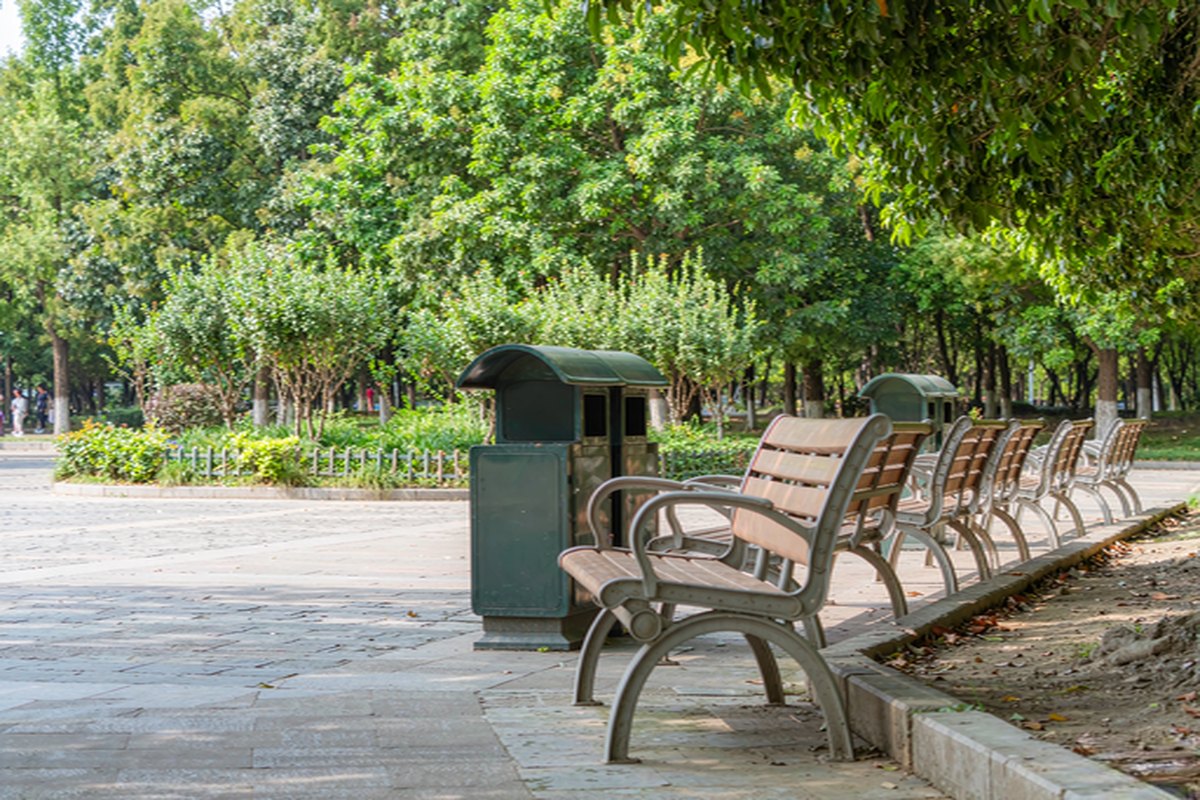
Start with places where people already stop: the railing in front of an enclosure, the edge of a playground, the shade tree beside a food kiosk, the top of a slope, and where a queue turns back on itself. A bench in one of those places is used all day; a bench on a straight path with nothing to look at is used by nobody.
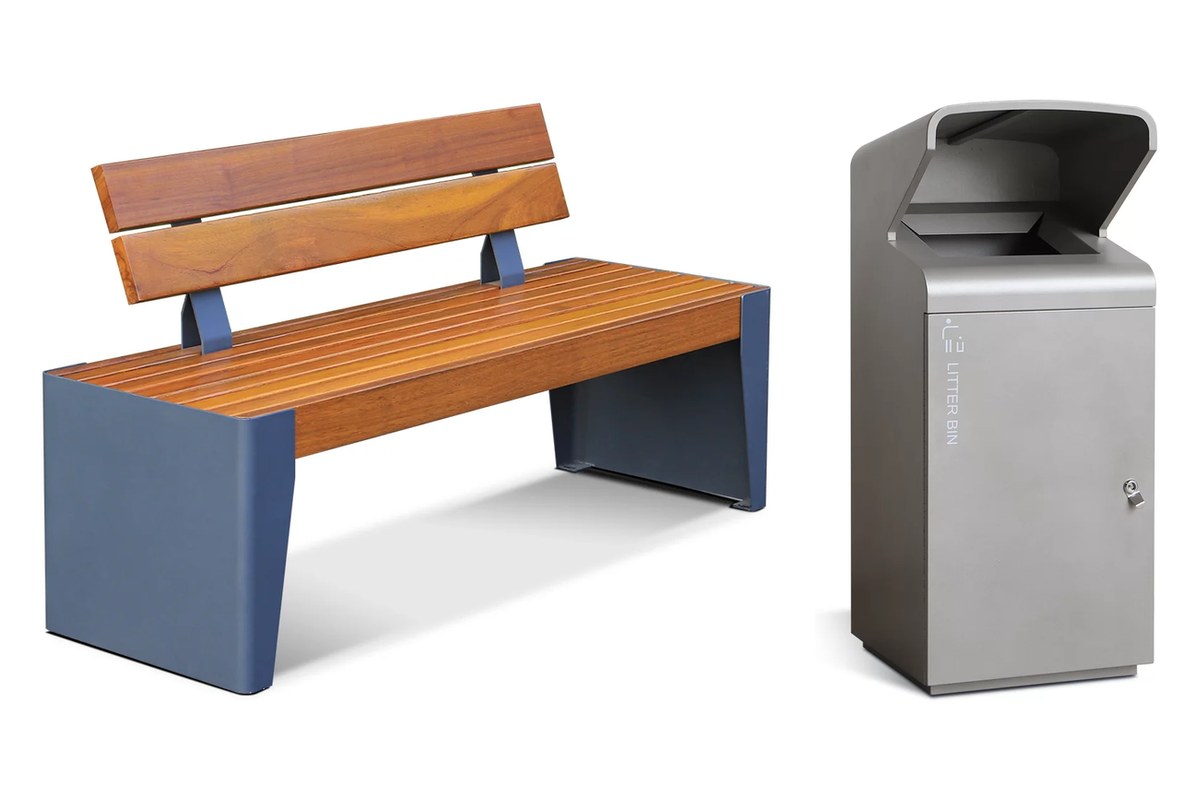
Face seats towards the attraction, not the path. Leave a stroller-sized gap at one end of each bench group rather than packing benches end to end. Mix two types: backless perches at queue lines and short-stay points, and full benches with backrests where a family will sit for a meal. The bench range covers both, from the 45 cm deep backless OTD-42 to the 69 cm deep OTY-68 with backrest.
Spacing follows the same logic: benches packed end to end become a wall nobody wants to sit in first, while gaps that are too wide tire older visitors. Our guide to bench spacing sets out working distances.
Which litter bins suit a high-dwell site?
Capacity should follow the food, not the path. A hooded 90 L unit at a picnic lawn fills faster than a 45 L bin on a quiet woodland trail, and an overflowing bin undoes a lot of careful landscaping. Hooded openings also keep rain out and hide the contents, which matters when the bin appears in every photograph.
| Zone | Suggested model | Capacity | Footprint |
|---|---|---|---|
| Entry plaza, exit route, picnic lawn | OTB-84 | 90 L | 45 x 45 x 107.6 cm |
| Food court, sorting pairs | OTB-422 | 80 L per unit | 48 x 35 x 95 cm |
| Main promenade, high traffic | OTB-14 | 60 L | 50 x 33 x 98 cm |
| Pathside, viewing decks | OTB-37 | 45 L single or twin | 35 x 35 x 76 cm |
| Sheltered or indoor-style areas | OTX-02C | 55 L | 40 x 32 x 94 cm |
Two details belong in the same conversation. The opening: a hooded or flap lid slows rain and birds but also slows disposal, so queue lines and food courts usually want the most open mouth the site tolerates - our comparison of litter bin lid types covers the trade-off. The emptying route: a 90 L bin is only useful if a crew can lift the bag out without tilting the unit.
How do tables, planters and ash columns fit the loop?
Picnic tables turn a patch of grass into a lunch stop. The OTZY-09 measures 150 x 163 x 78 cm and seats a family group; the OTZY-19B comes in 150 or 180 cm lengths at 165 cm wide and 76 cm high. Both need a firm, level base - loose gravel under a table leg is how tables start to rock.
Planters do the quiet work: separating a seating bay from a service route, holding a themed hedge, stopping people cutting across a lawn. Cylindrical steel planters such as the OTHP-04, at 30 or 35 cm diameter and 30-70 cm high, move easily when a zone is re-planned. The planter range also covers larger boxes for trees and screening.
Ash columns belong where smoking is permitted and away from food, queue lines and children's play areas. A freestanding unit such as the OTMY-02, 29 cm in diameter and 108 cm high, is easy to relocate if the smoking point moves, unlike a wall-mounted ashtray.
What should the specification say about cleaning and repairs?
Attractions clean harder than most public sites: pressure washing, disinfectant, chewing gum, spilled drinks. Powder-coated galvanized steel carries the widest colour range and touches up on site; stainless steel costs more but takes repeated scrubbing with no coating to chip. Both appear across our outdoor bin range.
Then record the consumables: fixing type and bolt size, touch-up paint reference, slat profile, lid or liner size. A spare-parts list built at order stage is cheaper than a custom re-run two seasons later. Our note on spare parts and refurbishment planning sets out what to log.
How do you keep a large site consistent?
Fix the palette and the fixing system before the first zone is ordered, then buy in phases against that record. Themed areas can differ in colour and planting without differing in bolt pattern, slat width or bin lid, which is what lets one maintenance crew look after the whole site.
Build one mock-up zone first: three benches, two bins, a table and a planter, used for a month. It shows whether the seat height suits older visitors, whether the bins fill faster than the schedule assumes, and whether the colour holds under the site's own trees. Completed installations are in our projects gallery; for a zone-by-zone schedule, send us the site plan.
Frequently asked questions
- What outdoor furniture does a zoo or theme park need?
Most sites need four groups: seating (perches at queue lines, full benches at viewpoints), bins sized to the food outlets, picnic tables at lawn and food areas, and planters that separate seating from service routes. Ash columns only where smoking is permitted.
- How many litter bins should a theme park have?
There is no fixed ratio. Work from dwell time and food: place a 60-90 L hooded bin at every eating area, every exit from a food outlet and every picnic lawn, then add 45-60 L units along routes so a bin is visible from most seating. Check the emptying schedule against the capacity before opening, and adjust after the first busy weekend.
- What materials suit zoo and theme park furniture?
Powder-coated galvanized steel is the usual choice because it carries themed colours and can be touched up on site. Stainless steel suits zones that are washed and scrubbed frequently, and is common for bins near food preparation. Timber and composite slats add warmth where the setting calls for it, provided fixings and cut ends are protected.
Specifying furniture for a public site? Send us the drawings or the site plan and we will confirm sizes, fixings and finishes with you.