
At a glance
- Stadium concourses concentrate crowds into short bursts, so bin capacity and servicing access matter as much as bin count.
- Hooded 90 L bins such as the OTB-84 are built for event-day loads, with lockable service doors and removable inner liners.
- Sorting stations - OTB-422 (80 L per unit) or OTB-45W (30 L × 2 + 50 L) - give recycling a fixed, visible home at entry and exit points.
- Galvanized and stainless steel benches (OTY-42, OTY-68) anchor with pre-drilled base holes and stay aligned through crowd surges.
What does a stadium concourse need between events?
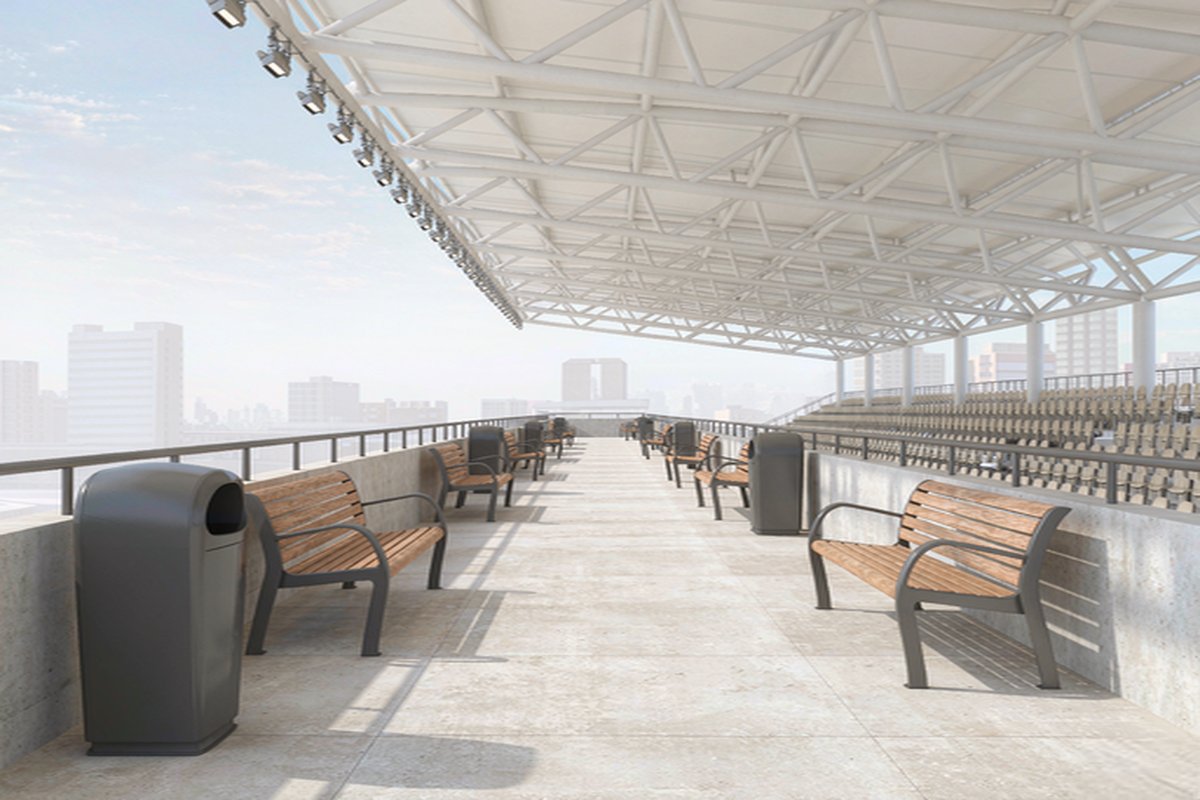
Walk any stadium concourse ten minutes after a match and you will see the same picture: full bins, litter drifting along fence lines, and crews moving fast against the clock. Between events, the same spaces sit empty and exposed to rain and sun. Furniture for this environment therefore has to answer two different demands at once - absorb an intense peak, and then survive quiet days outdoors without deteriorating.
That is why venue teams tend to specify fewer, larger, better-built units rather than many light ones. A hooded outdoor litter bin in powder-coated galvanized steel takes weather and cleaning chemicals in stride, and a stainless steel option near food zones simplifies wipe-down routines. Fixed installation matters too: pre-drilled base holes and matching anchor bolts keep bins and benches exactly where the crowd-flow plan put them, which is also a safety issue when thousands of people move through narrow passages.
How much bin capacity does an event-day crowd need?
There is no universal formula for bin counts at venues - crowd size, dwell time and catering mix all move the number. What experienced operators agree on is the placement logic: cluster capacity where people actually stand still. Gate lines, concourse corners, seating-block entrances and exit funnels are the natural points, because people linger there long enough to use a bin.
The LVEN OTB-84 was designed around exactly this pattern. It offers a 90 L single-bin capacity in a compact 45 × 45 cm footprint, 107.6 cm tall, with a hooded top opening that shields contents from rain and discourages oversized items from being forced in. The lockable front service door and removable metal inner liner mean a two-person crew can service a whole cluster quickly between sessions - pull the liner, carry it to the collection point, done. Ground fixing through pre-drilled base holes keeps the unit stable even when crowds lean on it.
Which benches cope with stadium use?
Concourse seating is transient - people perch, eat, wait for friends, leave. The priority is sturdy frames and slat layouts that clean fast, not deep comfort. The OTY-42 (150 or 180 cm long, 50 cm wide, 78 cm high, galvanized or stainless steel) fits this brief: long enough to seat several people, narrow enough to keep walkways clear, and simple enough for nightly wash-downs.
Where the venue wants spectators to settle - hospitality terraces, family zones, the area around a training pitch - a deeper seat earns its space. The OTY-68 runs 150 or 180 cm long at 69 cm wide and 80 cm high in stainless steel, giving a roomier perch while keeping the same fixed-installation logic. For a fuller treatment of backrests and armrests, see our guides on backrest vs backless benches and armrests and dividers.
Where do recycling stations fit best?
Sorting only works when the station is obvious and unavoidable. At venues, that means entry and exit points where the crowd moves slowly, not mid-concourse where people stream past. Two LVEN layouts cover most cases. The OTB-422 offers 80 L per unit with a covered opening and lockable door, and two units can be paired into an 80 L × 2 sorting layout. Where three streams are needed, the OTB-45W provides a 30 L × 2 + 50 L compartment layout in a 94.5 cm wide body, with an independent lockable door and separate removable liner per compartment. Custom sorting labels are printable on both models, which helps visitors sort correctly even in a hurry.
For smaller kiosks or club-level refreshment corners, the OTB-30 delivers a 40 L × 3 layout in a 96 cm wide frame, with two-compartment versions customizable. Our article on waste sorting station layouts covers how to match stream counts to actual waste profiles.
How do you manage smoking at the gates?
Most venues designate smoking areas outside the security line, and the practical problem is that cigarette butts end up everywhere else. Freestanding ash columns placed inside the designated area - set back from queue lines and gates - give smokers an obvious target. The OTMY-02 is a stainless steel column 29 cm in diameter and 108 cm high, tall enough to be spotted across a concourse and simple for cleaning crews to empty after events. Our guides on ash column placement and bin fire prevention cover the siting and safety details in depth.
| Zone | Main challenge | Suitable LVEN models | Key spec points |
|---|---|---|---|
| Gate lines & exits | Peak litter bursts | OTB-84 | 90 L, hooded opening, lockable door, removable liner |
| Concourse walkways | Transient seating | OTY-42 | 150/180 × 50 × 78 cm, galvanized or stainless steel |
| Hospitality & family zones | Longer dwell | OTY-68 | 150/180 × 69 × 80 cm, stainless steel |
| Entry/exit sorting | Recycling compliance | OTB-422 / OTB-45W / OTB-30 | 80 L per unit; 30 L × 2 + 50 L; 40 L × 3 layouts |
| Designated smoking areas | Butt litter control | OTMY-02 | Stainless steel, 29 cm D × 108 cm H |
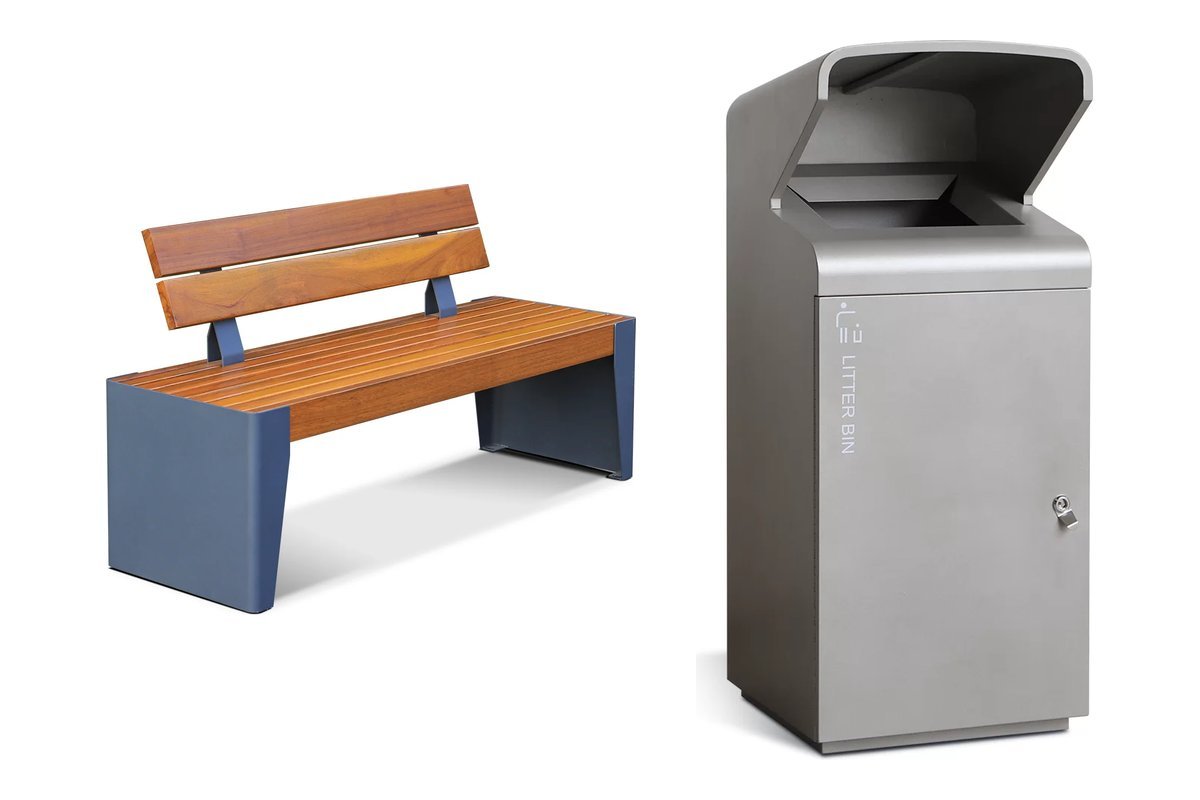
Brought together, these choices form a concourse kit that can be rolled out zone by zone as budgets allow: bin clusters at the gates, benches along walkways, sorting stations at the entries, ash columns in smoking areas. If you are mapping furniture onto an existing venue plan, our high-traffic plaza guide and anti-theft fixings overview cover the surrounding decisions, and you can browse completed installations in our projects gallery.
Frequently asked questions
- How many litter bins does a stadium need on an event day?
There is no single formula, because crowd size, dwell time and catering layout differ from venue to venue. A common planning approach is to cluster large-capacity bins at natural waiting points - gate lines, concourse corners and exits - rather than spacing small bins evenly. Hooded 90 L units such as the OTB-84 give each cluster enough capacity to survive a full event cycle, and the lockable service door plus removable liner lets crews empty a cluster quickly between sessions.
- Which benches work well on a stadium concourse?
Benches with galvanized steel or stainless steel frames and simple slat layouts are easiest to maintain. The LVEN OTY-42 runs 150 or 180 cm long at 78 cm high, which suits quick turnover seating, while the deeper OTY-68 (69 cm wide, 80 cm high, stainless steel) gives spectators more room at hospitality-facing zones. Backrests help longer dwell areas, and fixed anchoring through pre-drilled base holes keeps rows aligned after crowd surges.
- Where should ash columns go at a sports venue?
Ash columns work best at the edges of designated smoking areas, set back from gates and queue lines so cigarette butts are not flicked into crowded walkways. A freestanding stainless column such as the OTMY-02 (29 cm diameter, 108 cm high) is heavy enough to stand securely on paved concourses and simple for cleaning crews to service after events.
Planning furniture for a stadium, arena or training complex? Send us your zone layout and our team will suggest models, quantities and fixing options for each area.