
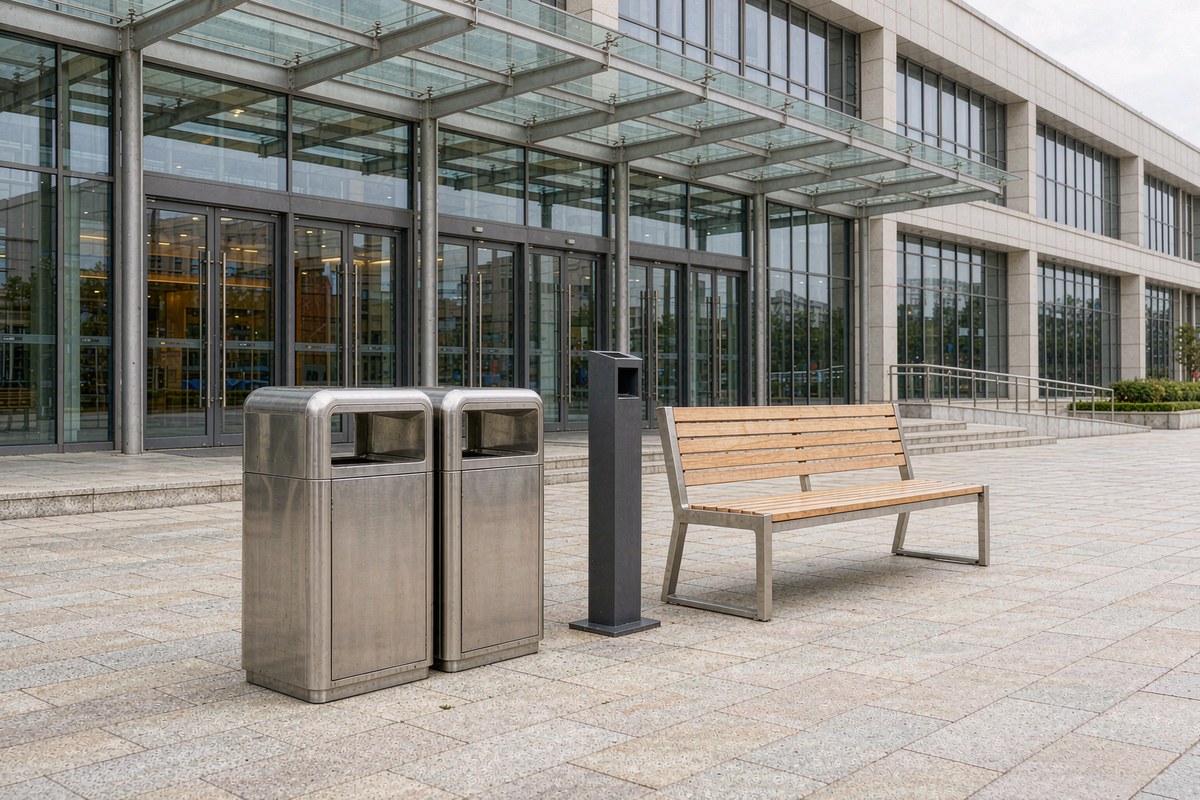
At a glance
- Crowds arrive in waves, not steadily — size bins and seating for the peak burst at arrivals and exits, not the daily average.
- Covered-opening bins in 304 stainless or coated galvanised steel keep entrances presentable between cleaning rounds.
- Seat people in sheltered pockets beside the flow, never across it, and concentrate ash columns only at designated smoking points.
- Fix everything down: bolted or embedded bases, anti-tamper screws and lockable bin doors for the cleaning crew.
What makes transport forecourts different from other public spaces?
Three things change the specification. First, the load pattern: passengers arrive in surges tied to timetables and flight waves, so a forecourt is empty one minute and packed the next. Second, the users: many carry luggage, follow signage under time pressure, and will not backtrack to find a bin. Third, the operation: the space is cleaned on a fixed schedule by a facilities team, usually in short windows between peaks, so furniture has to make that work easy rather than fight it.
Layout follows from those constraints. Forecourts mix pedestrians with taxis, buses and service vehicles, so the furniture plan starts by protecting the walking corridor from the entrance to the interchange — wide, straight and free of obstacles. Bins, benches and ash columns sit in the residual pockets beside that corridor: against facade columns, at the edge of taxi ranks, beside waiting shelters. Heavy steel planters can double as a soft edge where vehicles and pedestrians meet, guiding movement without the visual bulk of barriers. Anything that interrupts the desire line gets dragged out of position within weeks, so the plan that respects it is the one that survives.
Which litter bins survive an interchange environment?
Capacity matters less than handling. A bin that overflows at the entrance line undoes the whole cleaning schedule, so the specification that works combines a generous liner with a covered opening — hooded tops keep wind, spilled drinks and paper from re-entering the stream — and a lockable access door so only the crew can open it. Lift-out liners with handles let one operative swap a full liner in under a minute during a peak. For the entrance zone itself, brushed stainless steel litter bins hold their appearance under constant contact; along approaches and car-drop zones, galvanised steel with an outdoor powder coating delivers the same structure at a lower cost. The trade-offs between the two finishes are set out in stainless steel vs powder-coated steel litter bins.
Sorting is now expected at major interchanges. Multi-compartment bodies — litter one side, recyclables the other — work best where signage on the bin itself is simple and pictorial, because passengers decide in about two seconds. Place the sorting station where people are already standing still: beside ticket machines, at taxi ranks, outside arrival gates. A moving crowd will not stop to sort.
How should seating and ash columns be arranged?
Seating belongs where waiting actually happens: taxi ranks, pick-up zones, outside arrival halls, beside smoking shelters. Choose steel-framed park benches with backrests, because forecourt waits are longer than park stops and passengers with luggage use the backrest to steady themselves. Slats in hardwood or PS plastic-wood keep the seat usable in both summer heat and winter cold, which bare steel never does. Keep every seat out of the main corridor — a bench across the flow becomes an obstacle, a trolley bumper and a complaint generator at once.
Ash columns follow a stricter rule: they exist only where smoking is permitted, and they go where smokers already stop — outside the entrance line, at shelter exits, near designated areas. Grouping a steel ash column with a litter bin at each of those points removes the excuse for ground cigarette butts, and sizing the liner to the emptying round keeps it from overflowing. The siting method is the same one detailed in choosing ash columns for smoking zones: follow the smoker, not the floor plan.
Which materials and finishes hold up around the clock?
Forecourts stack stresses that most parks never see: de-icing salt dragged in on trolley wheels in winter, cleaning chemicals on a daily schedule, and constant contact from luggage and trolleys. Finishes that look fine in a catalogue fail here in one season if they are chosen on price alone. The table below summarises what holds up.
| Material / finish | Why it fits a forecourt | Watch-outs |
|---|---|---|
| 304 stainless steel | Resists salt and cleaning agents, stays presentable at entrances, wipes down fast | Shows scratches and fingerprints; brush the grain vertically |
| Galvanised steel + outdoor powder coating | Cost-effective for high-quantity approaches; colour-matchable to wayfinding | Touch up chips promptly — salt finds every scratch |
| Hardwood or PS plastic-wood slats | Comfortable across seasons, replaceable slat by slat | Specify UV-stable finishes; dark slats heat up in direct sun |
| Cast or heavy steel bases, bolted down | Survives trolley and vehicle contact; deters unauthorised moving | Plan anchor points with the paving contractor, not after |
How do you install without disrupting operations?
Transport hubs are never closed for furniture, so installation is planned like a logistics exercise. Work in zones during the lowest-traffic hours, keep anchor drilling away from expansion joints and under-floor services, and stage deliveries so the forecourt never becomes a storage yard. Bolt-down bases with anti-tamper fixings suit most retrofits; embedded anchors are worth the extra concrete at vehicle-facing edges. Supplying spares — extra liners, touch-up paint, a few slats — with the first delivery keeps small damage from turning into replacement requests.
Programmes of this scale are familiar territory for us: LVEN has supplied public-area facilities for major venues and events, including the Beijing Winter Olympics support programme and the Canton Fair exhibition venue, and the same discipline applies to interchange forecourts. The projects page lists the references we can discuss publicly. If you are specifying a forecourt or interchange, send the layout to our contact page and we will return a zoned proposal with quantities, finishes and fixing details.
Frequently asked questions
- What litter bins are best for airports and metro stations?
- Covered-opening bins in 304 stainless steel at entrances and 50–100 L galvanised steel bodies with outdoor powder coating along approaches. Choose lockable access doors, lift-out liners with handles, and multi-compartment bodies where recycling streams are separated.
- How do you stop cigarette litter around station entrances?
- Place ash columns exactly where smokers already stop — outside the entrance line and inside smoking shelters — pair each cluster with a litter bin, and size the liners to the emptying round so they never overflow.
- How often should forecourt litter bins be emptied?
- Tie emptying to the cleaning round rather than a fixed clock: at minimum once per daily peak cycle at entrances, more often during holidays and events, and always by swapping full liners instead of topping them up.
Need this specified for your own site? Send us the scene, quantity and finish requirements.
Get a quote