

At a glance
- Wall-mounted ashtrays suit door-side smoking points where floor space is tight and footfall is channelled past a single wall.
- Freestanding ash columns suit open plazas, smoking shelters and designated zones away from entrances.
- Compare capacity, ground clearance and servicing access before price; the location decides the type more than the budget does.
- LVEN's OTMY range covers freestanding columns in stainless and powder-coated galvanized steel, from 25 cm square to 108 cm-plus in height.
What is the difference between a wall-mounted ashtray and an ash column?
Both products do the same job: they give a smoker a safe, visible place to extinguish a cigarette instead of the ground or a planter. The difference is in what each demands from the site. A wall-mounted ashtray borrows the building's structure, so it costs nothing in floor space and sits exactly at the point where people already stop, such as beside a side door or under a canopy. What it needs is permission to drill, a wall that can carry it, and a maintenance routine that reaches it safely.
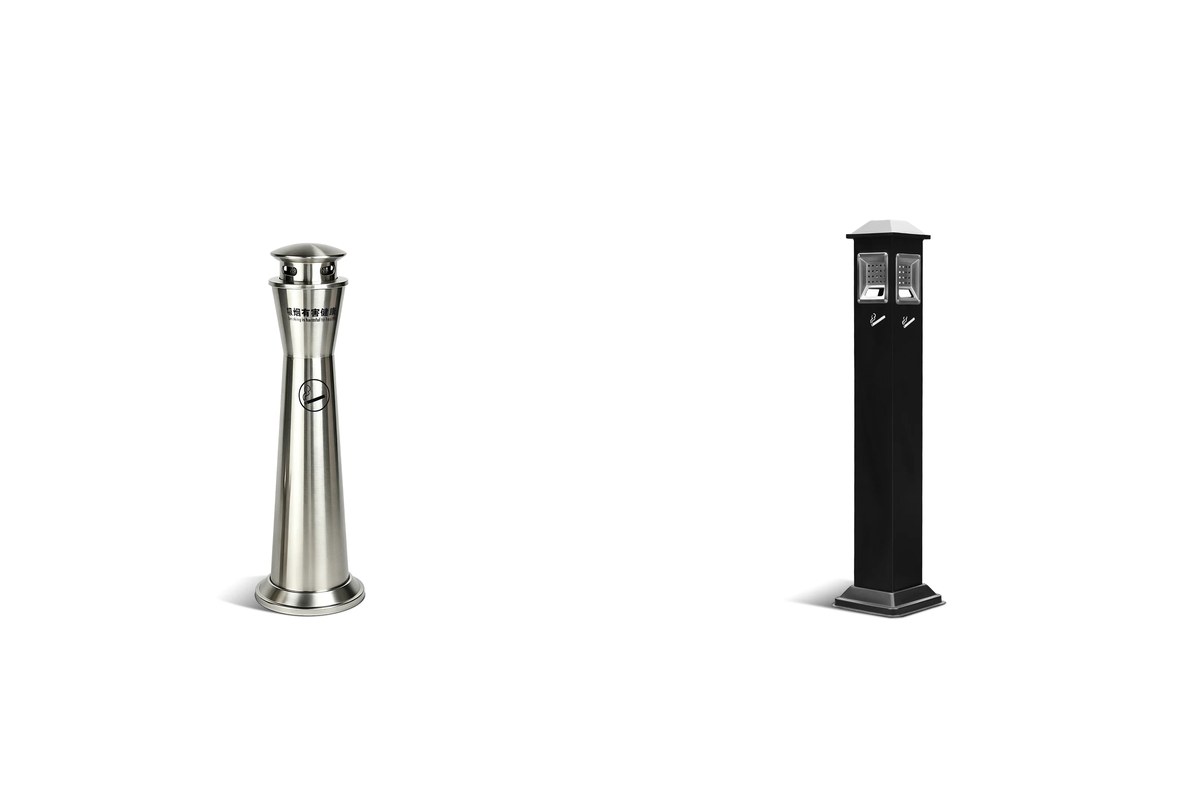
A freestanding ash column carries its own structure. It needs a patch of firm ground and space around it, but it can stand wherever smokers actually gather, not just where a suitable wall happens to be. Because the receptacle is larger and the body is a self-supporting tube or box, it holds more butts between empties, reads clearly from a distance, and can be anchored against wind and theft. Most campuses end up needing both types rather than choosing one forever.
When does a wall-mounted ashtray make more sense?
Choose the wall-mounted type when smoking is pushed right up against a building: a designated spot beside a staff entrance, a recess under a canopy, a loading-bay corner where smokers shelter from the rain. In those locations, a column standing in the middle of a narrow passage would obstruct the route, while a unit on the wall sits out of the traffic line. Wall mounting also suits heritage façades and narrow urban pavements where every centimetre of ground space is contested.
The trade-offs are real, though. Capacity is small, so the unit must be emptied often, sometimes daily at busy door-side points. Installation depends on the wall owner, which in leased buildings means negotiating with a landlord. And a wall-mounted ashtray only serves smokers who pass that wall, so a site with scattered smoking corners needs many units, each with its own servicing stop.
Where do freestanding ash columns perform better?
Any open setting favours the column. Smoking shelters, campus courtyards, park entrances, transport forecourts and the edges of office plazas all have space for a slim post, and smokers find a floor-standing receptacle at eye-level height quickly because it reads like street furniture rather than an accessory. One column can serve a whole sheltered area, its larger capacity absorbs a week of use at moderate traffic, and it moves with the smoking policy: if the designated zone shifts two years from now, the column shifts with it.
Columns also pair naturally with litter bins. Placing a column beside a general bin at a seating cluster means one servicing stop covers both, and smokers get an unambiguous answer to the question of where the cigarette goes. The placement distances, sightlines and wind rules are covered in detail in our ash column guide for smoking zones, and the same forecourt logic applies at stations and terminals as described in our airport and metro guide.
Which materials and dimensions should you compare?
Whichever type you buy, check four things: capacity, material, stability and access. The table below shows the LVEN freestanding range with real figures from the product pages, so you can see what a working column specification looks like.
| Model | Dimensions | Material and finish | Best suited to |
|---|---|---|---|
| OTMY-02 | Ø 29 cm × 108 cm high | Stainless steel, brushed body | Entrances and plazas where a polished, hygienic look matters |
| OTMY-04 | 25 × 25 × 113 cm | Galvanized steel, powder-coated | Shelters and courtyards; square body anchors firmly and resists corrosion under the coat |
| OTMY-08 | 28 × 28 × 118 cm | Galvanized steel, powder-coated | Higher-traffic zones that need extra capacity and a taller visual signal |
Stainless steel suits the highest-visibility positions and wipes clean in seconds; if you are weighing grades against budget, our comparison of 201 vs 304 stainless steel explains what changes between them. Powder-coated galvanized steel is the volume workhorse, the same pairing used across our outdoor litter bins. Full specifications and finishes sit in our ash column range.
How do you plan smoking points across one site?
Treat smoking hardware as a network, not a set of individual purchases. Walk the site, mark where smokers actually stand today, and decide which of those points stay, move or close. Every point that survives needs one receptacle of the right type: wall-mounted where the point hugs a building, a column where it stands in the open. Then plan the servicing round so one route covers all points together, the same way litter bins follow a fixed collection circuit as set out in our collection route guide.
Two last details save money later. First, anchor freestanding columns properly, because an unanchored column in an open plaza migrates, tips in wind and disappears; the fixing options are the same family as in our anti-theft fixings guide. Second, order the spare keys, liners or inner buckets with the first delivery rather than after the first loss, following the advice in our spare parts guide.
Tell us the site type, the number of smoking points and the exposure, and we will recommend a mix of models with dimensions and finishes, then quote the package.
Frequently asked questions
- What is the difference between a wall-mounted ashtray and a freestanding ash column?
- A wall-mounted ashtray fixes to the building beside a door or under a canopy, takes no floor space and needs small, frequent empties. A freestanding ash column stands on its own base anywhere smokers gather, holds more between services, reads clearly from a distance and can be anchored against wind and theft. Door-side points suit wall units; open plazas, shelters and courtyards suit columns.
- Where should freestanding ash columns be placed on a campus?
- Place a column at each designated smoking point, a few metres from entrances and away from door swings and accessible routes, on firm ground where it is visible from the shelter or seating it serves. Pair it with a general litter bin where smokers also carry packaging or cups, and anchor the base so it cannot migrate or tip in wind.
- How often should outdoor ash receptacles be emptied?
- Empty before the receptacle looks full, because an overflowing unit sends butts to the ground and defeats its purpose. Wall-mounted units at busy door-side points often need a daily check, while freestanding columns with larger capacity typically run on the same weekly servicing circuit as the site's litter bins. Add stops after events, peak seasons and windy weather.
Equipping smoking points across a campus, park or transport site? Send us the plan for a column-by-column recommendation.
Get a quote