

At a glance
- A working range of roughly 8-12 mm between seat slats handles drainage, drying and comfort on most public benches.
- Solid timber needs more allowance than composite: Jatoba, Bintangor and pine move with moisture, while PS poly wood and WPC move with heat.
- Keep the gap constant down the seat and across the backrest; uneven gaps read as poor quality and collect debris.
- Check the dimension against finger and heel entrapment, and against whatever the maintenance crew uses to clean the bench.
Why does the gap matter at all?
Three things depend on it. Water: a bench that puddles after rain keeps users away for hours, and standing water on timber feeds mould and breaks down the finish. Debris: leaves, wrappers and grit fall through a well-set gap, while a tight joint traps them where they hold moisture. The body: the gap is part of how a seat feels, how clothing catches and how much surface is usable.
There is also a manufacturing argument. The gap is the tolerance the bench gives itself: space every slat evenly and the bench looks deliberate at three metres; let it wander a few millimetres and the same bench looks improvised.
What gap suits timber slats?
Timber moves across the grain, not along it. A 45 mm hardwood slat can swell in a humid summer and shrink in a dry winter, so the gap must stay open when the slats swell. In practice 8-12 mm is the band that works: wide enough to drain and to let air reach the surface, narrow enough that a seat still feels like a seat.
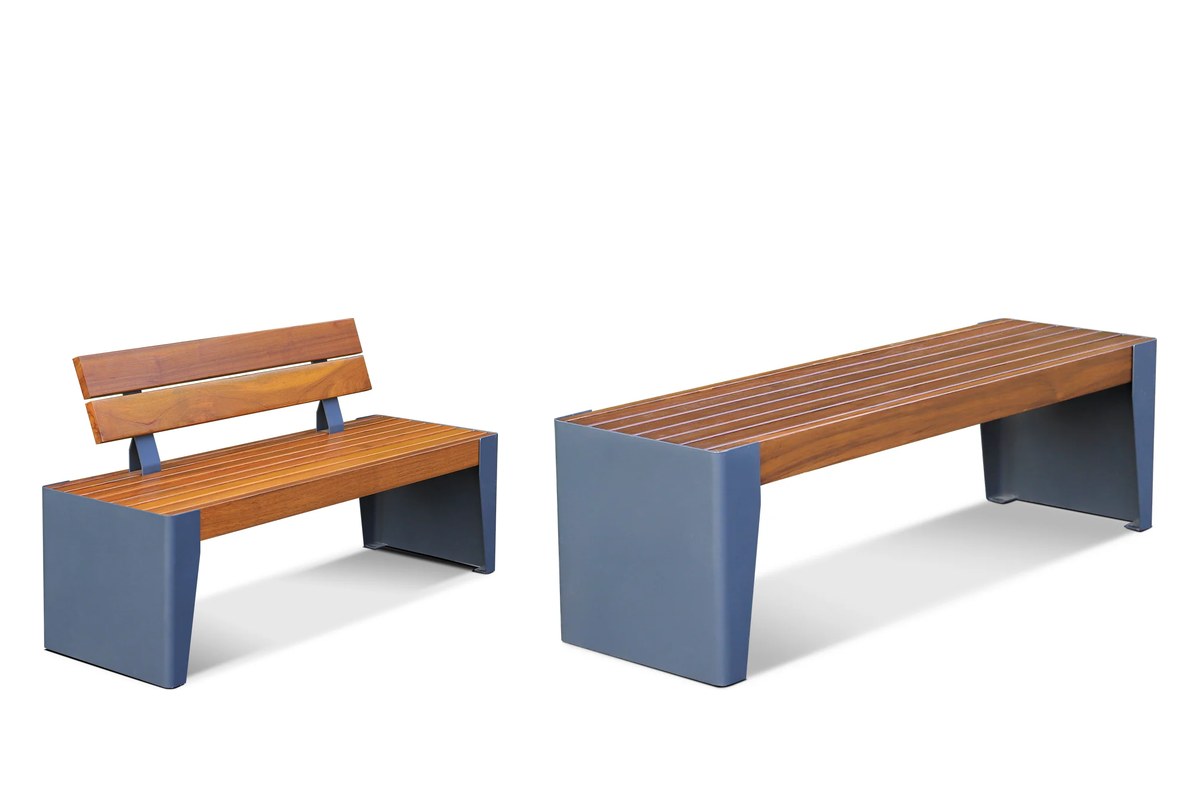
Species change the detail, not the principle. Our OTY-42 uses wooden seat slats on a galvanized or stainless steel frame at 150 or 180 cm long, 50 cm deep and 78 cm high. The backless OTD-42 uses solid Jatoba or pine at 45 cm deep and 45 cm high, and OTY-38 uses Bintangor slats. Jatoba is dense and stable, pine moves more, Bintangor sits between them - so a pine bench in a wet climate earns the wider end of the range, and every cut end should be sealed before assembly.
How is it different for composite and metal slats?
PS poly wood and WPC are extruded profiles: consistent width, no water absorption, but real heat expansion, and a long run of dark composite in direct sun grows more than the same run in shade. That makes the fixing detail more important than the gap - slats should move under the screw head rather than be clamped until the profile bows. The OTY-54 and OTD-29 both use PS poly wood slats on stainless steel frames.
Metal slats behave differently again. Perforated or slatted steel seats, such as on OTY-25A and OTY-25E, do not move with moisture at all, so the gap is purely a drainage, comfort and cleaning decision and can be tighter. The risk shifts to the coating: a narrow gap between coated slats is hard to clean and easy to chip.
How do you avoid trapping fingers and heels?
Any opening in public furniture is a potential trap, and the gap between slats is the one people sit on. The safe logic is binary: either the opening is too small to admit a finger, or large enough that anything entering can be withdrawn easily. Openings that admit a fingertip but grip it are the ones to design out - the same applies to heels and to the seat-to-backrest gap.
We treat 8-12 mm as the drainage band for timber, then check each design against the project's own safety specification, because requirements differ between markets and between parks, schools and transit stops. A bench at a playground edge deserves a more conservative reading than one on an office forecourt.
How do you keep the gaps even on site?
Assembly sets the gap, so method matters as much as the drawing. Lay the slats out and fix from the centre outwards, using a spacer block at each end of every slat. Working from one end accumulates error; working from the centre splits it. On knock-down benches such as the OTY-68, that sequence is the difference between a fair face and a wavy one.
Then check the whole seat before final tightening: sight down the row, measure two or three gaps rather than one, and confirm the slat ends sit flush. Curved benches need the spacer measured on the chord, not along the arc, or the gaps will open towards the outside edge. Our guide to replacing a park bench slat covers the same discipline for repairs.
| Slat type | Typical slat width | Working gap | What to watch |
|---|---|---|---|
| Solid hardwood (Jatoba, Bintangor, pine) | 30-50 mm | 8-12 mm | Seasonal movement; seal cut ends and re-check after the first wet season |
| PS poly wood and WPC | 40-60 mm | 8-10 mm | Thermal expansion; allow movement under fixings, do not over-clamp |
| Powder-coated steel or aluminum slats | 20-40 mm | 10-15 mm | Coating edges; a wider gap is easier to clean and less prone to chipping |
These are working ranges from public bench detailing, not a substitute for the project specification. Confirm them against the drawings, the safety requirements and the maintenance method before slats are cut.
What happens to the gap over time?
Timber gaps usually widen. Slats dry out and shrink across the width, so the 10 mm set in the workshop can read noticeably wider after a dry summer, and a screw that was not re-tightened lets the slat drift. That is why an inspection should include a hand check along the seat, not just a look at the frame.
Composite gaps close in heat and return in the evening, which is normal. What is not normal is a slat that stays bowed or a fixing pulled through the profile - both point to over-tightening at installation. Metal slats barely move, so any change there is damage, not settlement. Our comparison of wood, composite and aluminum slats sets out how each family ages.
If you are detailing a bench for a specific climate or safety regime, send us the drawings and we will confirm slat width, gap and fixing together. Completed installations are in our projects gallery.
Frequently asked questions
- What is the standard gap between bench slats?
There is no single universal figure. Public bench detailing commonly uses about 8-12 mm between seat slats, which drains rainwater, lets the surface dry and stays comfortable to sit on. Wider gaps suit coated metal slats and easier cleaning; narrower gaps suit composite profiles that move with heat. Confirm the figure against the project specification and local safety requirements.
- Should bench slats have gaps at all?
Yes. Without gaps, water sits on the seat after rain, timber stays damp and the finish breaks down faster, and grit becomes impossible to clear. A gap also lets air reach the underside of the slat, where rot and mould usually start. The gap should be continuous and even, including between the seat and the backrest.
- How wide should the gap be on a wooden bench?
For solid hardwood and pine slats, 8-12 mm is a practical band. Wood moves across the grain, so the gap has to stay open when the slats swell in a humid season and must not grow excessive when they shrink in a dry one. Dense species such as Jatoba move less than pine, and sealing cut ends before assembly keeps the movement predictable.
Detailing a seating scheme? Share the drawings and we will confirm slat width, spacing and fixing for your climate.