
At a glance
- Attached benches share the table frame, so the set cannot be dragged apart or lose a bench to another part of the site.
- The catalogue width of an attached set is the bench-to-bench dimension: 142 cm to 180 cm across the LVEN range.
- Separate benches give a clear floor for sweeping, mowing and hosing, but they drift and need their own anchoring.
- Attached sets suit unsupervised parks, schools and campsites; detached layouts suit staffed terraces and event lawns.
What counts as an attached bench?
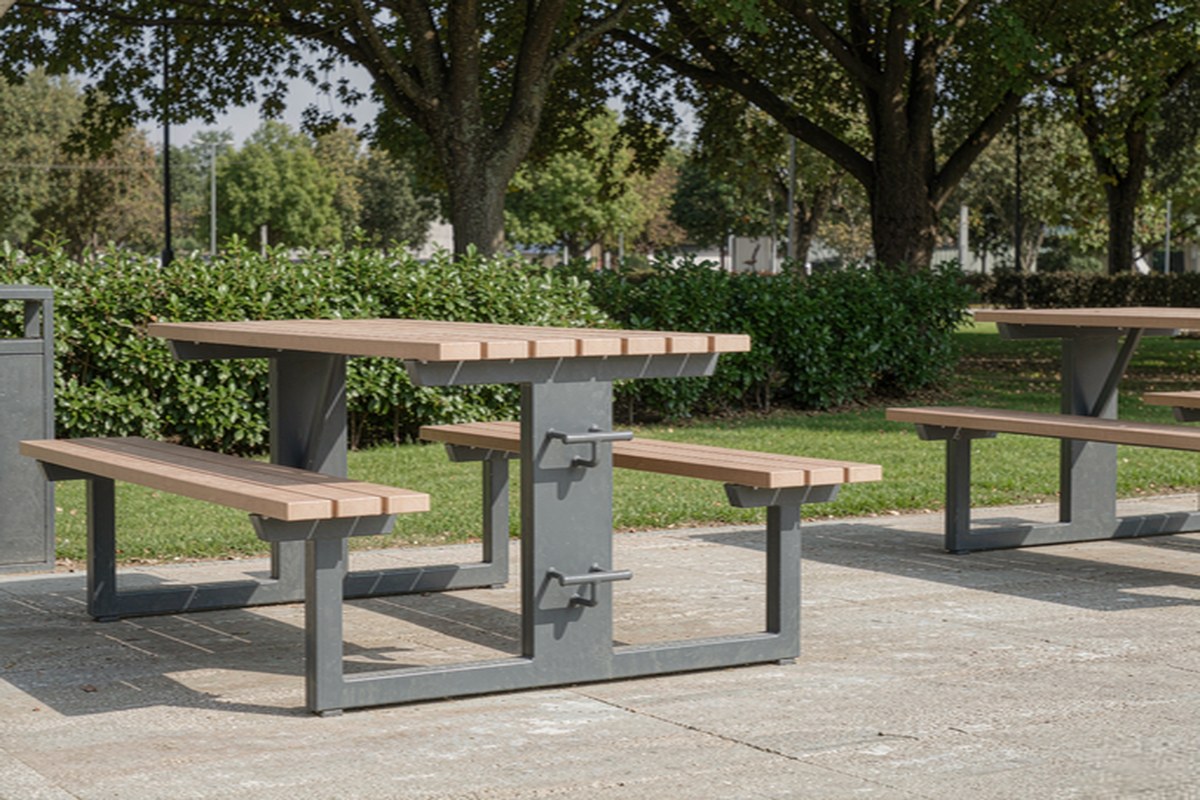
An attached bench is mounted to the table's own leg frame, usually with brackets that share the same welded or bolted frame as the tabletop. The unit behaves as one structure: the load on the bench passes into the table legs, and the bench cannot be repositioned without dismantling something. Most picnic sets in the LVEN range are built this way, including the OTZY-19B, the OTZY-20 and the wider OTZY-18 and OTZY-22 sets, each carrying two benches on the table frame.
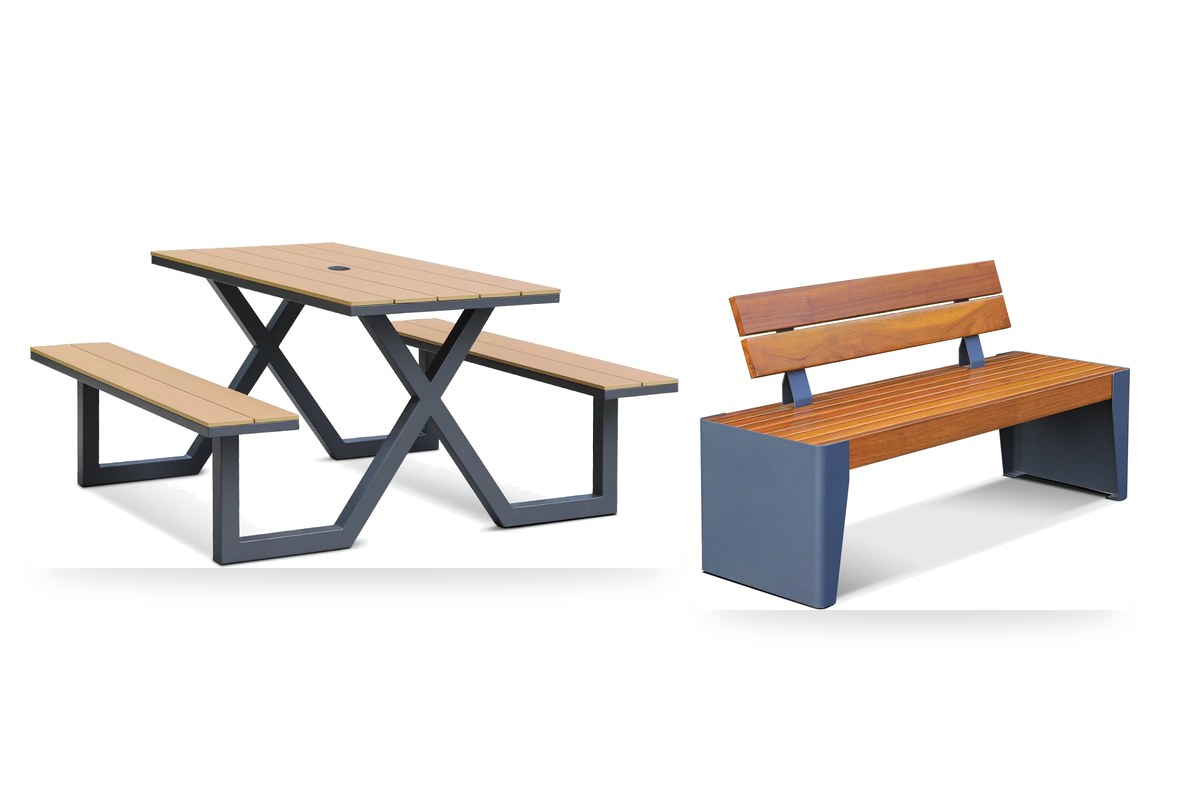
Detached seating means a table with separate benches placed beside it, drawn from a bench range such as the OTY-42 or the OTD-42. Nothing is shared but the paving. That freedom is the point: one bench on one side, a longer bench than the table, or an end left open for a wheelchair.
How much ground does each layout take?
With attached sets the numbers are fixed at the factory, so the site plan can be settled early. These are the published dimensions of the current range:
| Model | Set dimensions (L × W × H) | Frame and slats |
|---|---|---|
| OTZY-20 | 180 × 142 × 76 cm | Galvanised steel frame, WPC slats |
| OTZY-09 | 150 × 163 × 78 cm | Carbon and galvanised steel, all-metal |
| OTZY-19B | 150 or 180 × 165 × 76 cm | Galvanised steel frame, PS wood slats |
| OTZY-18A | 180 × 170 × 75 cm | Aluminium alloy frame, PS wood slats |
| OTZY-18C | 180 × 180 × 76 cm | Galvanised steel frame, PS wood slats |
| OTZY-22 | 180 × 180 × 76 cm | Galvanised steel frame, PS wood slats |
Read that width carefully: it already includes both benches, so a 165 cm wide set needs 165 cm of clear ground before circulation space is added. A detached layout with a table and two 45 cm deep benches can reach a similar overall width, but the pieces can be staggered, spread or reduced to one bench. The gain is rarely in total width; it is in the clear floor between table edge and bench, which is what a broom, a hose and a mower actually need.
Which layout is more stable and harder to move?
A one-piece set is difficult to shift and impossible to dismantle without tools, which is why it is the usual choice for parks, school grounds and campsites where supervision is thin. A separate bench can be dragged a metre at a time until it ends up in a quiet corner, so detached seating needs anchoring in its own right, covered in anti-theft fixings for public benches and bins. Attached sets still need the table anchored to the paving, for the reasons set out in how to anchor a park bench.
There is a structural difference worth knowing. Cantilevered benches put seat load into the table frame, so the frame, the brackets and the ground beneath the legs have to work together. That is fine on continuous paving or a concrete pad, and less fine on soft turf where one leg settles and the table rocks. Detached benches carry load into their own legs: more forgiving on uneven ground, but more separate fixings to inspect.
How does cleaning and mowing change?
Under an attached set there is a covered floor between the table and the two benches. Crumbs, leaves and wrappers collect there, a broom reaches most of it and a hose finishes the job, but no machine can get in. On grass an attached set needs a mown hardstanding or a paved pad, because a string trimmer cannot work around the frame without damaging the coating.
Detached seating clears the floor. Benches can be lifted aside for a deep clean, a sweeper or mower can pass between table and bench, and the slab can be jetted without soaking a fixed seat. The trade: loose benches collect litter at the feet and need putting back, which rarely happens without a marked position.
How do the two layouts affect wheelchair and pram access?
An attached set is approached end-on. The benches block the long sides, so the table end has to be left clear, and the set needs to be positioned with that end facing the path rather than the planting. Get that right and an attached set works well for a wheelchair user joining a group; get it wrong and the only approach is over a bench.
A detached layout is more flexible: one bench on one side, the other side open, or benches shifted to widen a side gap. For picnic areas that see wheelchairs, prams and mobility scooters, a practical arrangement is mostly attached sets with a few tables set up with a single bench and a clear end. The principles are in designing outdoor furniture for accessibility, and the wider layout question in laying out a picnic area with tables and bins.
How do you decide for a park, school or campsite?
- Count the group size: a 180 cm set seats a group at one table, a detached layout can be re-proportioned later.
- Check supervision: unattended sites favour one-piece sets, staffed terraces can use loose benches.
- Check the surface: attached sets want a continuous pad, detached seating tolerates grass and gravel.
- Check the spares plan: a damaged bench on an attached set means frame work, a separate bench is simply swapped.
For replacement planning across a mixed site, our guide to spare parts and refurbishment planning covers how the two approaches age. To specify a picnic area from scratch, send us the plan and group sizes and we will match set dimensions to the layout; the range is in our picnic tables and outdoor sets section, and you can request a quotation or review recent installations.
Frequently asked questions
- Are picnic tables with attached benches better than separate tables and benches?
- For unsupervised public sites they usually are, because the set stays in one piece, cannot lose a bench and needs one anchoring point. Separate benches are better where the layout has to stay flexible, where the ground is uneven, or where deep cleaning and mowing access matter more than rigidity.
- How wide is a picnic table with attached benches?
- In the LVEN range the bench-to-bench width runs from 142 cm on the OTZY-20 to 180 cm on the OTZY-18C and OTZY-22, with the OTZY-09 at 163 cm, the OTZY-19B at 165 cm and the OTZY-18A at 170 cm. That width already includes both benches, so circulation space has to be added on top of it.
- Can you add a wheelchair space to an attached picnic table?
- Not by removing a bench from a one-piece frame. The workable approach is to leave the table end clear and orient that end towards the path, so a wheelchair user can pull up to the tabletop. Where side transfer matters, use a detached arrangement with a single bench instead.
Planning a picnic area and unsure whether to fix the benches to the table? Send us the layout and group sizes for a set recommendation.
Get a quote