
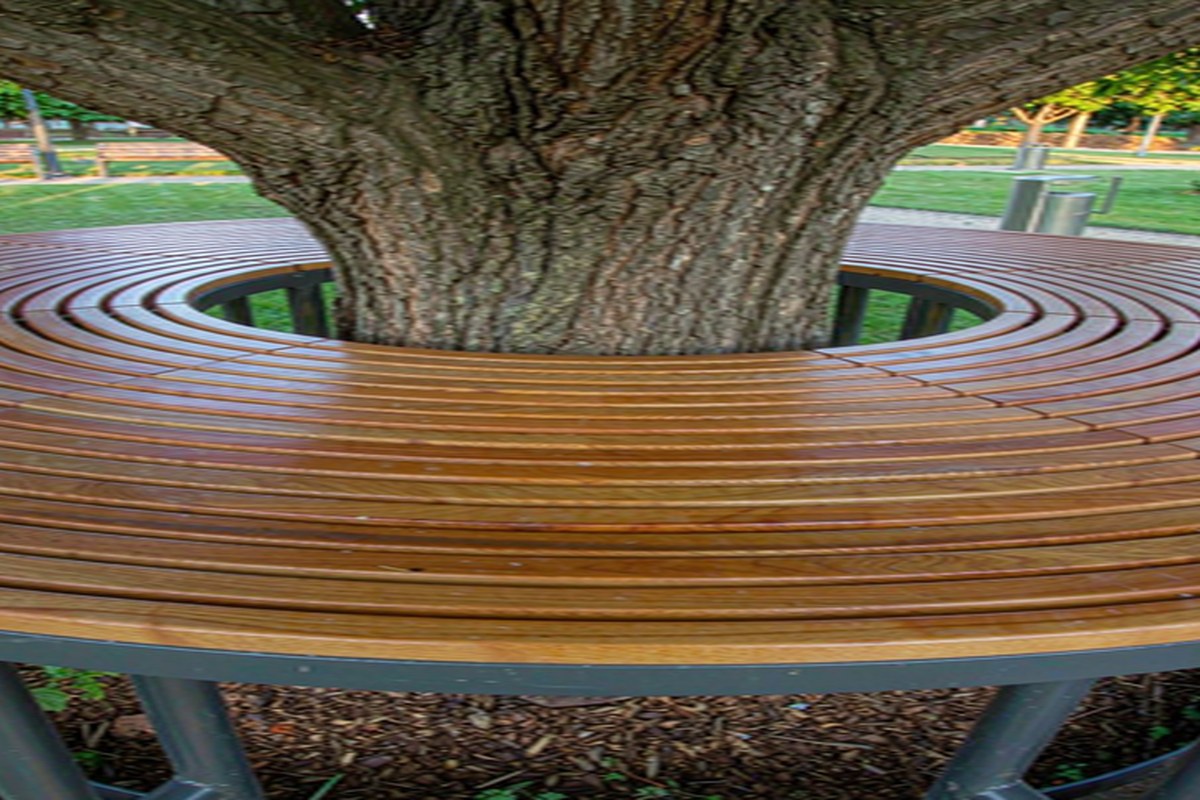
At a glance
- Size the inner ring for the trunk as it will grow, not as it is today — and keep the soil level inside unchanged.
- Never cut major structural roots; keep excavation shallow and locate any buried services before digging.
- Fixings matter: feet on a paved surround or shallow ground anchors protect the root zone far better than deep footings.
- Plan maintenance for both parties — slats and fixings on one side, mulch and trunk clearance on the other.
Why build seating around a tree instead of beside it?
Ground next to a tree is awkward for ordinary benches: the canopy drips, the roots heave, the trunk breaks every straight line. A ring bench turns all of that into an asset — shade becomes the reason people choose the seat, and the footprint stays the size of the existing tree pit.
There is a practical side too: in busy plazas and schoolyards, a surround ring protects what gets damaged first — the trunk and the soil over its roots — by keeping bicycles and vehicles away from the bark. Our tree bench and tree surround range exists for exactly this combination of seating and protection.
What should you check about the tree before you start?
Start with the species and its growth habit: two trees of the same trunk diameter today can need very different clearances. Ask the landscape manager or tree office for the species and any protection status — many cities require an approved method statement around protected trees.
Then look at the ground. Three checks decide most installations:
- Root flare and surface roots. Map where the major roots run: the ring can bridge small feeder roots, but its feet must not trench through large structural roots.
- Existing soil level and future mulching. Parks top up mulch over the years; if the ring is set to today's level the seat ends up low or mulch bridges against the slats. Set the finished height with future top-ups in mind.
- Buried services. Tree pits attract irrigation lines, lighting cables and drainage — locate them before digging.
Finally, check the trunk for lean and sway: a leaning trunk needs an even-but-generous gap, and a young tree moves in wind more than its diameter suggests.
How much space should the inner ring leave for the trunk?
The gap is the decision that most affects the tree's health. Trunk diameter grows every year, and bark must never press against the frame. A workable rule is to size the inner opening for the trunk's expected diameter in ten years — a generous gap on day one that looks right within a few seasons.
Just as important is what fills the gap: no soil heaped against the trunk, no gravel compacted over the root flare, no concrete spillage. If the surround is paved, stop the paving short of the trunk and finish with a permeable material that lets water and air reach the roots.
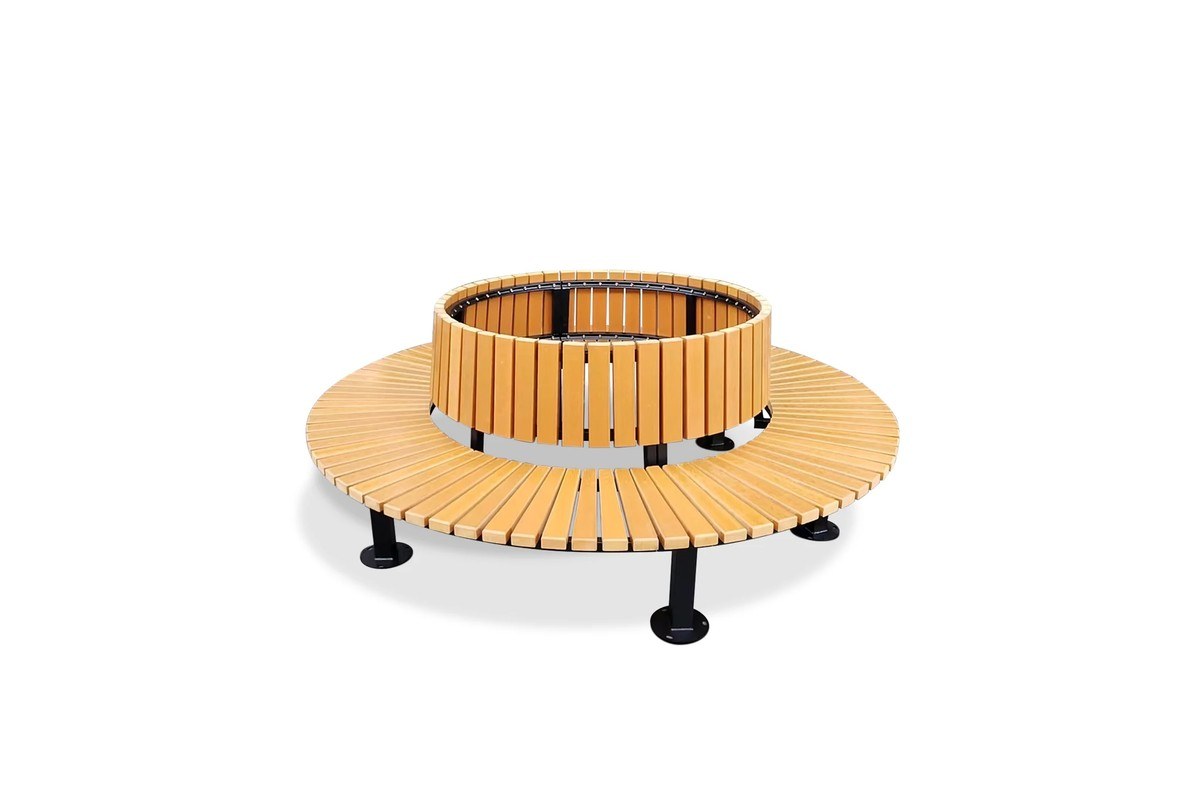
Because growth rates are hard to predict from a drawing, many buyers choose custom-sized surrounds: our round surround models can be made to a specified inner diameter, as described in our park bench range. For a young tree, plan for the mature diameter and add a temporary inner guard in the early years.
Which fixings keep the bench stable without damaging roots?
A ring bench is wide and shallow, and most of its stability comes from geometry rather than mass — good news for the tree, because the least harmful fixing is usually the shallowest one that still resists the loads a public bench sees.
The two approaches that coexist well with roots are a surface-mounted ring on a paved surround, anchored into the paving rather than the root zone, and shallow ground anchors set between major roots after they have been located. Both avoid the deep continuous footing that would sever roots across half the ring. Whichever you choose, the principles are the same as for any public seat — our guide to how to anchor a park bench covers fixing types and substrate checks in detail.
Where new paving is being laid, cast the anchor points first and confirm them against the bench template. Retrofitting works too, but keep drilling lines on joints or plain areas, not over visible roots.
One more detail is levelling: a ring standing proud on one surface root will rock and work its anchors loose. Shim at the feet during installation rather than forcing the frame down against the root underneath.
How do you keep the bench and the tree healthy together?
After installation, bench and tree share a maintenance schedule. On the furniture side: inspect fixings annually, re-tighten what the seasons have loosened, and watch the slats nearest the trunk, the shadiest and dampest spot on the whole bench. Material choice matters — see our bench slat comparison, and the seasonal routine in our winter protection guide.
On the tree side: keep mulch clear of the trunk, water during establishment years, and walk the ring once a season to confirm the gap is even. If slats begin to crowd the bark, the frame can be adjusted or the inner arc replaced with a larger one — far cheaper than removing a stressed tree. Re-check seat height too, because a mulch top-up changes the real-world dimension; the target range is the usual one, as set out in our park bench seat height guide.
The checklist below compresses the whole process into one page:
| Step | What to aim for | What to avoid |
|---|---|---|
| Survey the tree | Species, growth rate, protection status, trunk lean | Sizing the ring from trunk diameter alone |
| Map the ground | Surface roots, soil level, buried services located | Digging before locating irrigation and cables |
| Set the opening | Inner diameter sized for ~10 years of growth | A tight, concentric ring on a young tree |
| Choose fixings | Shallow anchors into paving or between roots | Deep continuous footings across the root zone |
| Finish and level | Shimmed feet, permeable surface, untouched soil level | Soil or paving built up against the trunk |
| Maintain | Annual fixing check, seasonal gap and mulch review | Forgetting the ring until something breaks |
Frequently asked questions
- How much space should you leave between a tree bench and the trunk?
- Leave a gap that fits the trunk as it will be in future years, not as it is on installation day: size the inner ring against the expected trunk diameter after ten or more years of growth, and keep the existing soil level inside unchanged. Trunks sway in wind, so the gap should be even all round.
- Can you install a tree bench without damaging the roots?
- Yes, if you avoid cutting through major structural roots and keep excavation shallow. Prefer fixings that sit in the top soil layer or on a paved surround, keep soil levels around the trunk unchanged, and route any drainage or cabling away from the root zone. If the tree is mature or protected, have an arborist review the fixing plan before work starts.
- What height should a tree bench seat be?
- The same range as any public bench: most seating is specified with a finished seat height of 420-450 mm, around 430 mm being a safe default. Because the ground around a tree can settle or be topped up with mulch, re-check the finished height against the actual surface after landscaping work is complete.
Planning a tree surround for an existing tree? Send us the trunk diameter and we'll quote the ring to match.
Get a quote