
At a glance
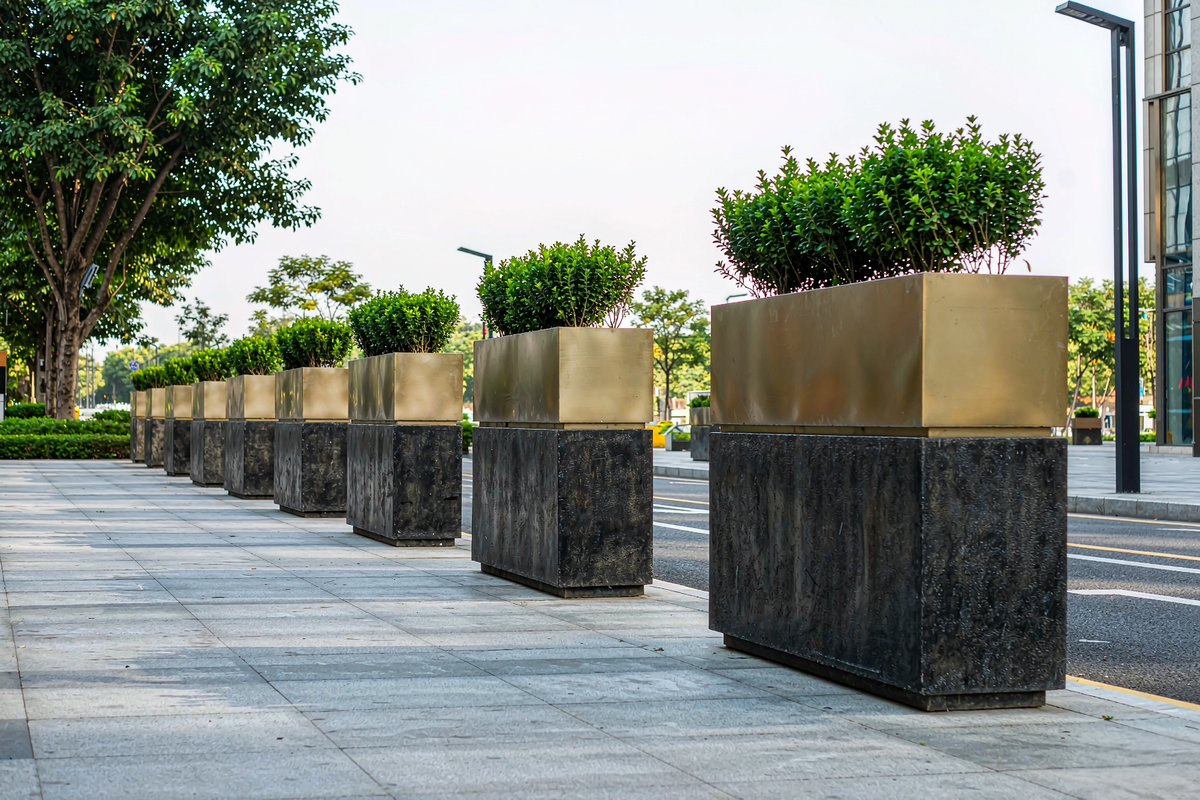
- Height is the key dimension: 700–1,000 mm separates movement without feeling like a wall.
- A width of 500–800 mm keeps planting healthy while holding a slim streetscape footprint.
- Run planters as continuous or near-continuous lines; gaps wider than about one body width invite cutting-through.
- Anchor or interlock heavy planters wherever vehicle contact is possible.
Why use planters for pedestrian separation instead of bollards or fences?
Bollards and railings separate efficiently, but they read as hardware: hard lines, no planting, and a defensive feel that many plazas, campuses and retail streets want to avoid. Planters do the same movement-control job while adding greenery, seasonal colour and a softer edge — and unlike a fence, a planter line can be reconfigured when a layout changes.
Planters also combine well with the rest of the streetscape. A planter run can carry park benches in its gaps, mark an outdoor dining zone, or lead people toward entrances alongside planters of matching sizes. The trade-off is honest: a planter is wider than a bollard and needs soil, drainage and maintenance, so the dimensions have to be chosen deliberately rather than picked from a catalogue photo.
What planter dimensions actually separate pedestrians?
Height does most of the separating. A low planter is an edge; a tall one is a barrier. Match the height class to the job:
| Planter height | What it does | Best used for |
|---|---|---|
| 400–600 mm | Guides movement and edges a space; low visual barrier | Plaza edges, wide promenades, planter-ledges people can sit beside |
| 700–900 mm | Blocks casual crossing, shields planting from brush-by damage | Walkways beside roads, forecourts, campus paths |
| 1,000 mm and above | Strong screen; breaks sightlines and wind | Perimeters, drop-off zones, roadsides with fast traffic |
The 700–1,000 mm band is the workhorse for pedestrian separation: high enough that stepping over it is a conscious, inconvenient act, low enough to preserve visibility for shopfronts, signage and natural surveillance. Above that, reserve tall planters for positions where screening matters more than openness.
How wide and how long should each planter be?
Width is a balance between soil volume and walkway space. Around 500–800 mm of width gives most shrubs and grasses a stable root zone — as a working rule, plan on at least 300–400 mm of soil depth for small shrubs, more for larger species — while keeping the planter line from swallowing the footway. Narrower units look elegant but dry out fast and topple more easily; wider units belong in plazas and medians where space is not the constraint.
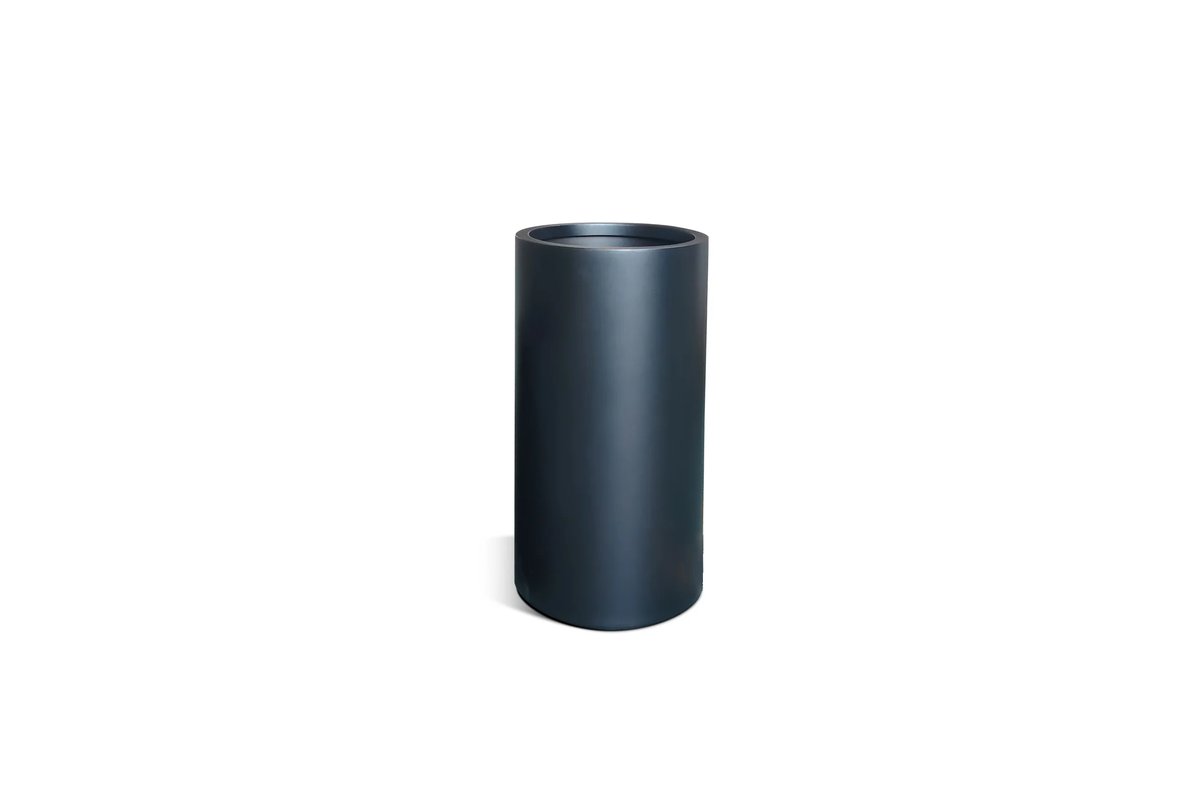
Length is where you buy efficiency. Long trough planters of 1,000–1,800 mm separate more linear metres per unit, mean fewer joints to align and fewer gaps to police, and simply look calmer than a chain of square pots. Round or cylindrical planters work as accents at ends and corners, where their shape reads as deliberate rather than repetitive.
Two practical details complete the dimension set. First, drainage: whatever the width, a planter used as a street barrier needs overflow holes at the base, or roots sit in water after every storm. Second, weight distribution: tall narrow planters hold most of their soil high up, so check that the base is proportionally deep or ballasted — a planter that tips in wind is a separation measure that creates a hazard.
How should planters be spaced and fixed along a walkway?
Keep gaps between units below roughly one body width — about 500–600 mm — so the line reads as continuous and nobody is tempted through. Where you must leave larger openings for crossings, driveways or fire access, make them look intentional: align them with desire lines, frame them with a change of planter height, or fill the gap with a bin or bicycle rack so the space has a job.
Fixing matters as much as spacing once a planter sits near traffic. Heavy concrete- or steel-bodied planters resist a shove, but on slopes, near drop-offs or wherever a vehicle could mount the kerb, anchor them to the paving or interlock them in groups — the same fixing logic used for street furniture in shopping-street planter schemes. Leave maintenance access on the planting side, and keep the planter line clear of door swings and loading zones. For how furniture clusters work together at transport hubs, see our forecourt furniture guide; for combining bins with a layout, the picnic area layout guide shows the same spacing logic.
Frequently asked questions
- What height should a planter be to stop pedestrians crossing?
- For separating pedestrians from traffic or guiding movement, most streetscape planters work best at 700–1,000 mm high. That height discourages casual stepping-over and shields planting, yet still allows sightlines and conversation across it. Below about 600 mm a planter reads as an edge rather than a barrier.
- How wide should a streetscape planter be?
- For separation duties, planters of roughly 500–800 mm width give enough soil volume for shrubs while keeping a slim footprint on the walkway. Anything wider eats pedestrian space and is better treated as a combined planter-bench element or a median island.
- How far apart should planters be placed along a walkway?
- Keep gaps between planters below roughly one body width — about 500–600 mm — so the line reads as continuous. If gaps must be larger for access or drainage, place them deliberately at crossings and service points rather than leaving random spaces that invite cutting-through.
Need this specified for your own site? Send us the scene, quantity and finish requirements.
Get a quote